

A Storm of Superlatives
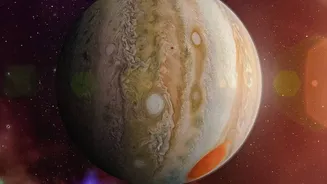
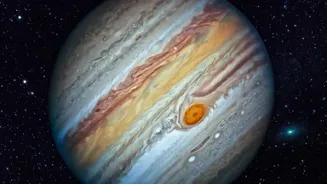
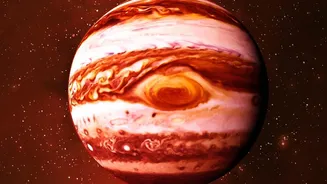
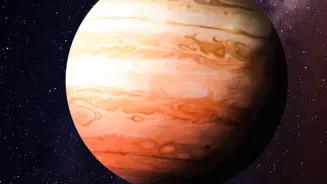
For at least 150 years, and possibly more than 350, astronomers have tracked a colossal, crimson-coloured storm on Jupiter. Known as the Great Red Spot, this anticyclone is a region of high pressure so vast that, for much of its observed history, it could
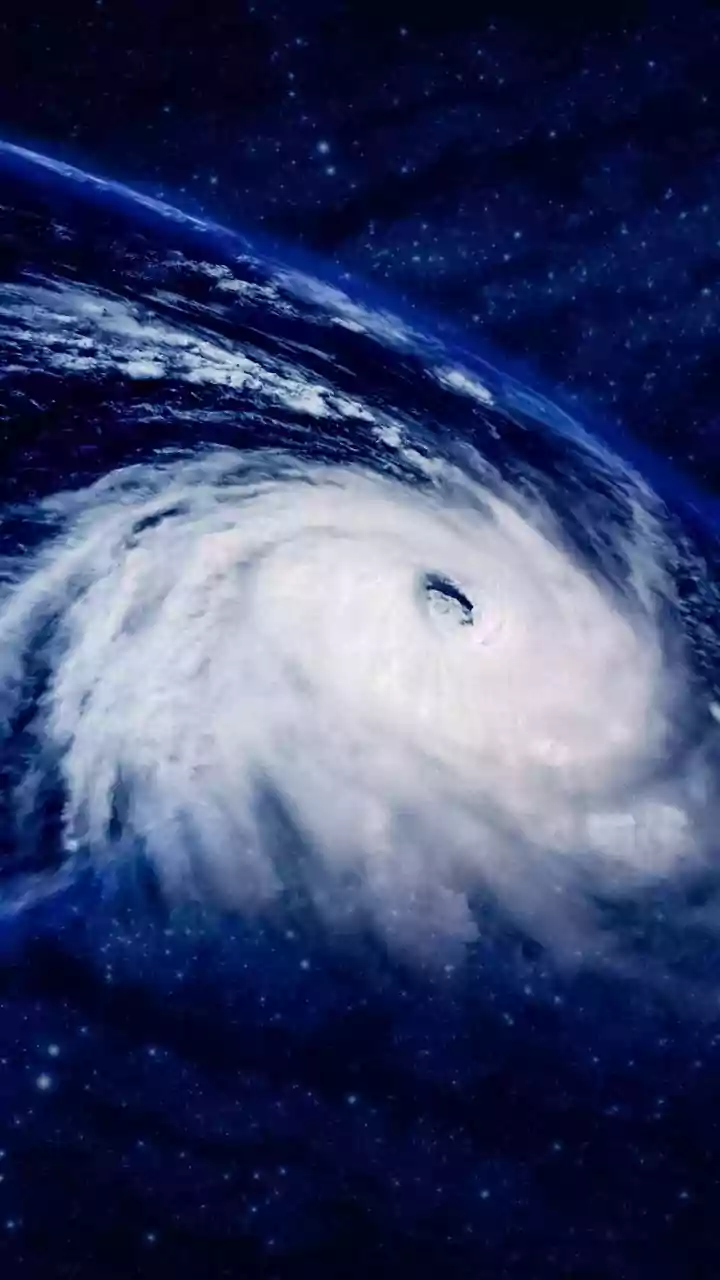
have comfortably swallowed our entire planet multiple times. Unlike hurricanes on Earth, which form over oceans and die out over land, Jupiter has no solid surface to provide friction. This allows its storms to persist for centuries, driven by the planet’s rapid 10-hour rotation and the immense heat churning within its gaseous interior. The Great Red Spot is the undisputed king of these storms, a permanent fixture in the southern hemisphere, trapped between two powerful jet streams that flow in opposite directions, forever spinning its clouds in a counter-clockwise frenzy.
The Paradox of a Shrinking, Accelerating Storm
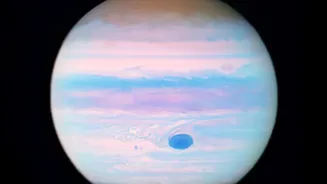
For all its might, the Great Red Spot has been shrinking for decades. Observations show it is now the smallest it has been since detailed records began, having lost much of its stretched oval shape to become more circular. Yet, in a fascinating paradox, new analyses of images from the Hubble Space Telescope reveal that its winds are getting faster. A long-term study tracking the storm between 2009 and 2020 found that the wind speeds in the storm's outer ring have increased by as much as 8 percent. These winds now exceed 640 kilometres per hour, a speed that dwarfs even the most powerful Category 5 hurricanes on Earth. So, while the storm itself is contracting, its outer edge is spinning with increasing ferocity.
What's Driving the Changes?
Scientists are working to understand this perplexing behaviour. It's not a simple case of the storm winding down. The increase in wind speed is subtle, amounting to less than 2.6 kilometres per hour per Earth year, a change so small it could only be detected by Hubble's consistent, high-resolution observations over more than a decade. In contrast to the accelerating outer band, winds in the storm's calm central region appear to be moving more slowly. Researchers theorise that the shrinking size and accelerating winds are interconnected. As the storm contracts and grows taller, it may be conserving angular momentum, much like an ice skater spins faster when they pull their arms in. The exact mechanics remain a mystery, but the data suggests the storm is undergoing a significant structural change.
New Views from Advanced Telescopes
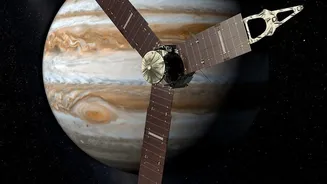
The latest generation of telescopes is providing unprecedented detail. Multi-telescope observations, including from the Juno spacecraft orbiting Jupiter, have helped map lightning and peer through the top layers of clouds. These studies revealed that dark features within the spot are not different coloured clouds, but actual gaps in the cloud cover, offering a glimpse into the storm’s deeper structure. More recent observations from Hubble have even shown the storm wobbling and oscillating in size over a 90-day cycle, jiggling like gelatin as it pushes against the surrounding jet streams. Scientists hope that by continuing to monitor these shifts, they can better understand the forces that have allowed the Great Red Spot to survive for so long and predict what its future might hold.