




Beyond Remote Control
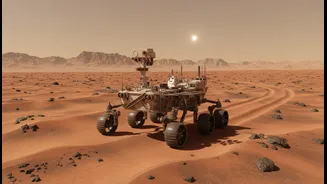
When you send a command to a Mars rover, you can't just grab a joystick. With a communication delay that can range from five to over twenty minutes each way, mission controllers on Earth are less like pilots and more like chess players, planning moves
far in advance. For decades, this has meant a slow, painstaking process. Engineers send a day's worth of instructions, the rover executes them, and the team waits for the results before planning the next step. This cautious approach was necessary for rovers like Sojourner and Spirit. However, NASA's latest plans, particularly for complex missions like Mars Sample Return, demand something far more sophisticated: true autonomy. This shift is not just an upgrade; it's a fundamental change in how we explore other worlds.
The Challenge of a New Frontier
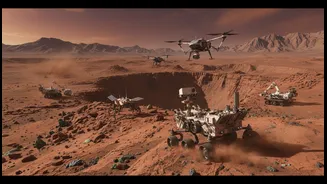
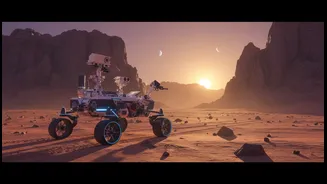
Missions like the Perseverance rover and the proposed Mars Sample Return campaign present challenges on a new scale. The goal is no longer just to analyze rocks in one area but to perform a complex series of tasks: identify scientifically interesting samples, collect them, store them, and eventually transfer them to another vehicle for a return trip to Earth. This interplanetary treasure hunt involves multiple robotic systems—landers, rovers, and ascent vehicles—that must work in concert without constant human guidance. Furthermore, NASA wants to explore more challenging terrain, like steep crater walls and rugged highlands, that were previously off-limits. This requires rovers that can navigate vast distances and make real-time decisions to avoid hazards, manage power, and ensure their own survival.
Smarter, Faster, and Safer
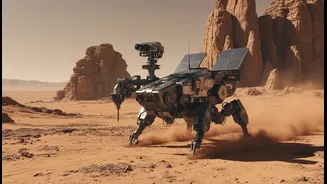
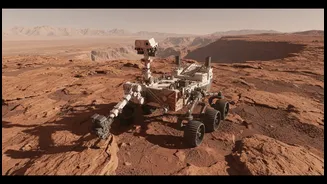
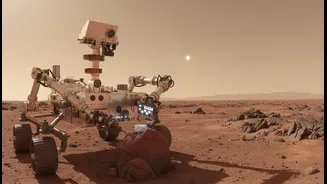
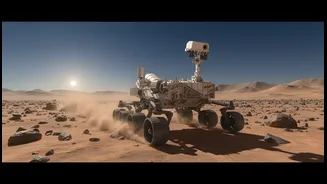
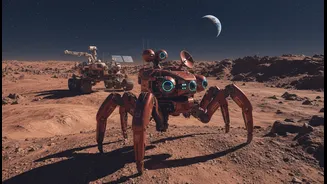
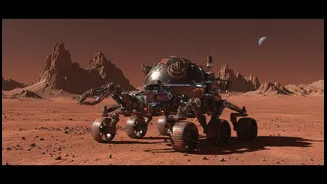
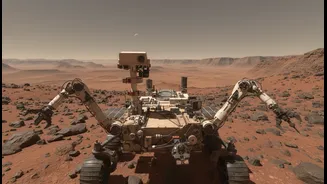
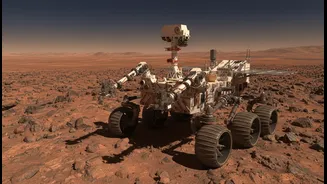
The next generation of Martian robots is being designed with unprecedented levels of artificial intelligence. The Perseverance rover already uses a system called AutoNav, which allows it to map its own route and drive much farther in a day than its predecessors. Recent tests have even seen the rover plan and execute drives using generative AI, analyzing orbital imagery and terrain data to chart its own course without human planners creating waypoints. Future rovers, like the ERNEST prototype being tested in the California desert, feature advanced mobility systems that allow them to climb over obstacles and adapt their gait to different surfaces. These machines use AI not just for navigation but also for science. An AI-powered instrument on Perseverance called PIXL can identify minerals of interest and decide on its own to perform a more detailed analysis, a capability known as 'science autonomy'.
From Mars to Your World
The technologies being pioneered for Mars have significant implications for life on Earth. The AI algorithms developed to navigate the treacherous Martian landscape are directly applicable to self-driving cars, which must also perceive their environment and make split-second decisions to ensure safety. The autonomous systems that manage power and mission tasks on a rover can be adapted for smart energy grids and automated logistics in warehouses. The need to operate robots in environments where human access is impossible—whether it's deep space, a collapsed mine, or the site of a natural disaster—is a powerful driver for innovation. By solving for the extreme case of Mars, NASA is creating a blueprint for autonomous systems that can operate more efficiently, safely, and independently in any complex environment.