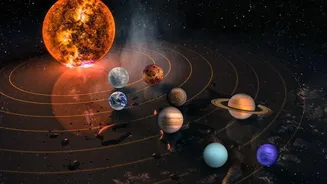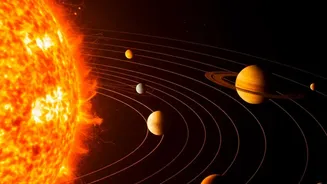

We tend to think of the solar system as a perfectly stable, clockwork machine. But what if it isn't? New research suggests that the Sun is constantly changing, and these changes could have long-term consequences for its largest planets.
Our Sun is Losing Weight
The Sun, like all
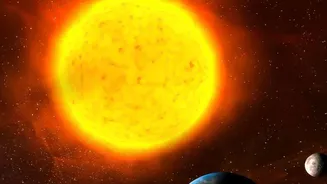
stars, is not a static object. It's a dynamic, fiery ball of plasma that is constantly losing mass in two main ways. The first is a steady stream of particles called the solar wind, which flows outward in all directions. The second is through fusion itself; when the Sun converts hydrogen into helium, a tiny amount of mass is transformed into the energy that lights and warms our world. This steady mass loss is incredibly small, causing Earth's orbit to expand by only about 1.5 centimetres per year. On its own, this slow, gentle change isn't enough to dramatically alter the solar system's architecture.
The Power of a 'Stochastic Kick'
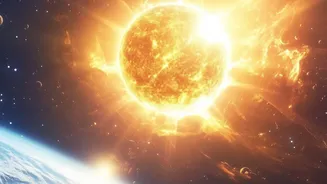
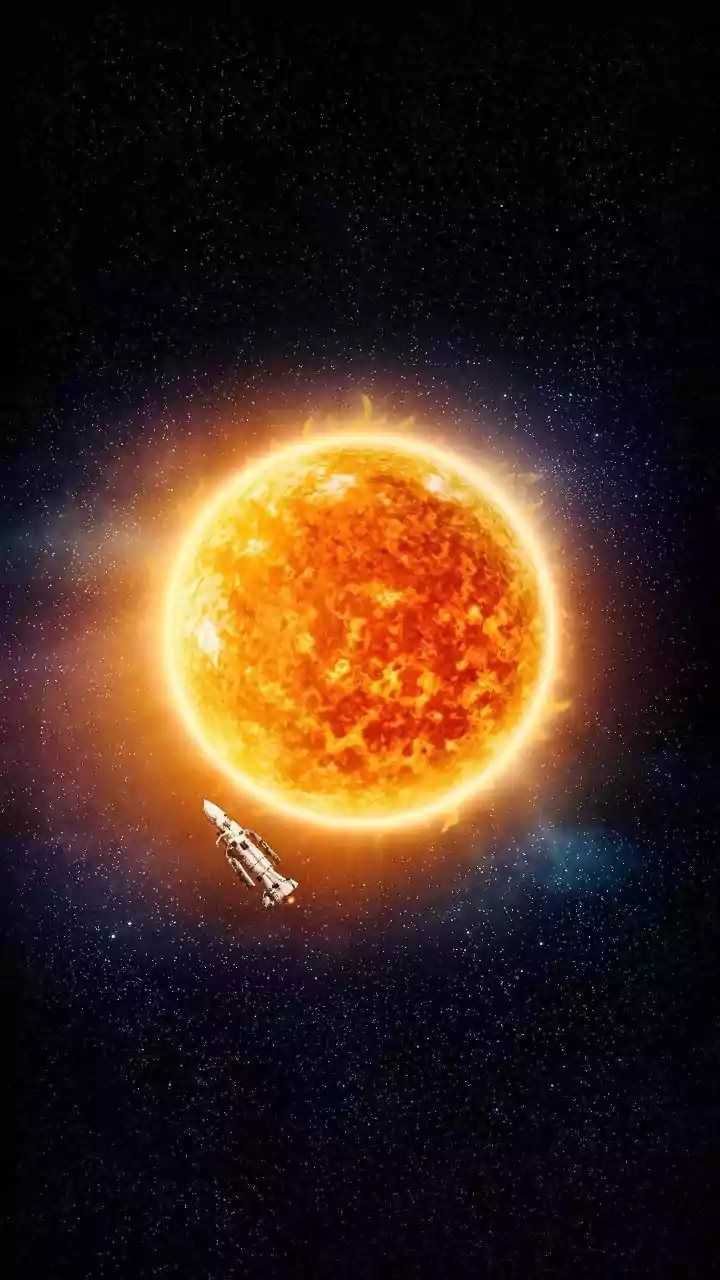
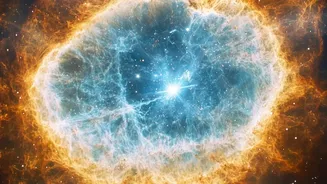
The headline's 'bursts' refer to something more dramatic: coronal mass ejections (CMEs). These are enormous, explosive eruptions of plasma and magnetic fields from the Sun's corona. For a long time, scientists modelled the Sun's future mass loss as a smooth, uniform process, like a sprinkler watering a lawn evenly. However, new simulations propose that in its later life, as it becomes a red giant, the Sun will shed mass in discrete, powerful, and randomly directed bursts. Imagine the Sun not as a sprinkler, but as a sputtering rocket engine, firing off bursts in different directions. Each asymmetric ejection gives the Sun itself a tiny 'kick' or recoil, subtly changing its position.
Why This Shakes the Giants
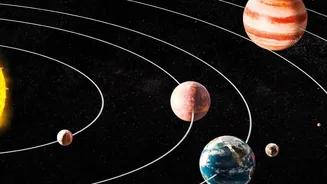
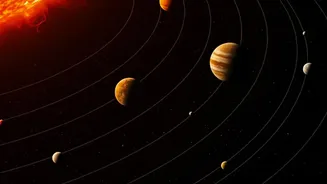
Gravity is a delicate dance. A star's mass is the anchor that holds its planets in their orbits. If the star's mass decreases, the planets' orbits naturally expand. But if the star itself is also being nudged around by these powerful, directional bursts, it adds a new layer of chaos to the system. The new research, published in 'The Astrophysical Journal Letters' by a team including Konstantin Batygin, suggests these 'stochastic kicks' could destabilise the orbits of the outer giant planets—Jupiter, Saturn, Uranus, and Neptune. While each individual kick is small, their cumulative effect over thousands or millions of years can nudge these giant worlds into more eccentric, or unstable, orbits.
A More Chaotic Future
Previous models predicted that the outer solar system would remain stable for an almost unimaginable length of time—perhaps a quintillion (a billion billion) years. Stellar flybys were thought to be the only real threat to this stability, and only in the very distant future. The new simulations dramatically shorten that timeline. By factoring in these asymmetric bursts, the models show that orbit-crossing instabilities and even the ejection of a planet from the solar system could occur. In some scenarios, this instability could begin even before the Sun has finished its evolution into a white dwarf, cutting the solar system's expected stable lifespan by a factor of a billion or more.
What About Earth?
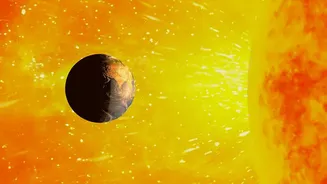
Fortunately, we don't need to worry about being flung into deep space. This projected instability primarily affects the outer planets, whose vast orbits are more susceptible to these long-term gravitational nudges. The inner planets face a more immediate, fiery fate. In about 5 billion years, when the Sun swells into a red giant, it will expand to engulf the orbits of Mercury, Venus, and almost certainly Earth. This new research focuses on the fate of the planets that survive this initial expansion, revealing that their long-term future may be far more chaotic than we once believed.