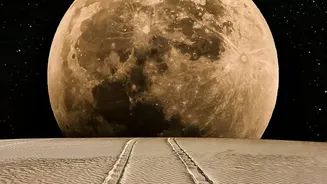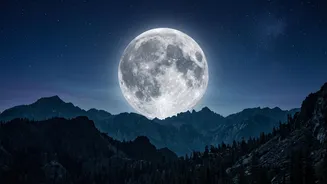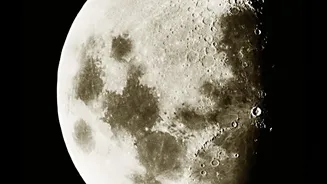

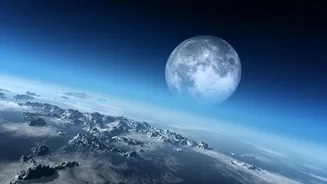
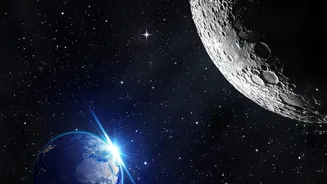
We’ve all seen it: a jaw-droppingly huge moon hanging just above the horizon. It feels almost close enough to touch. But is it real? Nope. It’s one of the oldest and most powerful optical illusions, and your own brain is the magician.
The Illusion We All Fall For
First, let's get
one thing straight: the Moon doesn't actually change size. Whether it's looming over a distant mountain range or perched high in the dead of night, its physical diameter and distance from Earth remain virtually the same. In fact, the Moon is technically about 1.5% smaller on the horizon because it's an entire Earth-radius farther away from you than when it's directly overhead. You can prove it's an illusion with a simple trick: hold a small pebble or your pinky finger at arm's length. You'll find it covers the Moon just as easily on the horizon as it does at its zenith. So if the Moon isn't getting bigger, what's really going on?
It’s Not Your Eyes, It’s Your Brain
The secret to the Moon illusion lies not in physics or atmospheric tricks, but in psychology. Your brain is wired to interpret the world in three dimensions, and it uses context clues to judge size and distance. When the Moon is high in the sky, it’s surrounded by a vast, empty expanse of black. There are no reference points. Your brain, lacking any sense of scale, defaults to perceiving it as a relatively small object against a featureless backdrop. But when the Moon is on the horizon, it’s framed by things we understand: trees, buildings, mountains, and the textured line of the landscape itself. Our brains see these objects and know they are far away. Because the Moon appears behind them, our brain concludes it must be incredibly distant—and therefore, enormous.
Meet the Ponzo Illusion
This mental shortcut has a name: the Ponzo illusion. Imagine a pair of railroad tracks converging in the distance. If you place two identical lines across the tracks, the one closer to the vanishing point will look significantly larger. Your brain assumes that because it's 'farther down the tracks,' it must be bigger to project the same size image onto your retina. The Moon on the horizon is like that farther line. The terrain and atmospheric haze create a sense of depth, like converging tracks, telling your brain the Moon is very far away. To compensate for this perceived distance, your brain inflates the Moon's size. High in the sky, without those tracks, the illusion disappears.
How to Break the Spell
This brings us back to the headline. If the horizon's context is what creates the illusion, removing it should break the spell—and it does. The simplest way is to look at the rising Moon through a paper tube. By blocking out the surrounding landscape, you remove the depth cues. The Moon, now isolated in your field of view, immediately seems to shrink back to its normal size. Another classic method is to bend over and look at the Moon backward through your legs. This bizarre posture disorients your brain and disrupts its normal processing of the scene, effectively canceling out the illusion. In both cases, you're not changing the Moon; you're just preventing your brain from running its usual size-distance calculation.