






The Universe's Most Precise Clocks
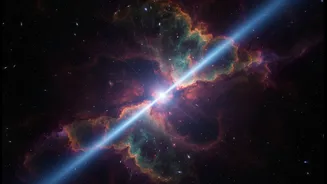
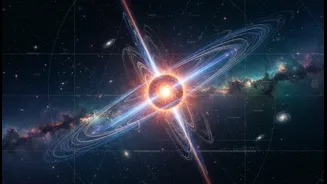
First, what exactly is a pulsar? It's a type of neutron star, the incredibly dense, city-sized remnant of a massive star that has gone supernova. What makes some of them special is their rapid rotation and intense magnetic fields, which channel beams
of radiation out into space. As the star spins, these beams sweep across the cosmos like a lighthouse. From our perspective on Earth, if we're in the path of that beam, we see a regular 'pulse' of energy. Some millisecond pulsars spin hundreds of times per second, and their rotational stability is so precise that it rivals atomic clocks on Earth. This predictable timing is the key to their scientific utility.
Building a 'Cosmic GPS'
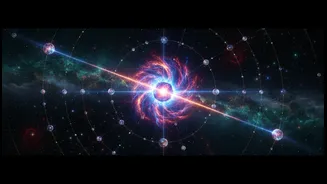
For decades, deep space navigation has relied on Earth-based systems like NASA's Deep Space Network (DSN), which involves sending signals from Earth to a spacecraft and back. This works, but it's slow and cumbersome, and as missions venture further into the solar system and beyond, the communication delays become a major bottleneck. The solution is autonomous navigation. This is where the pulsar map comes in. The concept, known as X-ray pulsar-based navigation and timing (XNAV), uses the precise signals from multiple pulsars to triangulate a spacecraft's position in space, much like how GPS uses satellites. A spacecraft equipped with an X-ray detector, like NASA's Neutron star Interior Composition Explorer (NICER) on the International Space Station, can measure the exact arrival time of pulses from several different pulsars. By comparing these arrival times to a pre-loaded map of where those pulsars are and what their timing should be, the spacecraft can calculate its own position to within a few kilometers without phoning home.
Probing the Extremes of Physics
Beyond navigation, this precise cosmic timekeeping opens a new window into fundamental physics. Neutron stars are laboratories for matter under conditions of pressure and density that are impossible to replicate on Earth. Studying the X-rays from these objects, as NICER does, helps scientists understand this exotic state of matter and determine the exact size and mass of neutron stars. This data puts theories of nuclear physics to the ultimate test. Furthermore, by monitoring an array of pulsars across the sky—a project known as a Pulsar Timing Array (PTA)—scientists can look for tiny, correlated changes in their pulse arrival times. These variations can signal the passing of gravitational waves, the faint ripples in spacetime predicted by Albert Einstein. Detecting these nanohertz-frequency waves, likely produced by supermassive black holes merging at the centers of galaxies, provides a new way to observe the universe and test general relativity in extreme scenarios.
The NICER and SEXTANT Experiments
The primary instrument behind this leap forward is NICER, an X-ray telescope mounted on the ISS since 2017. While its main goal is to study neutron star composition, an enhancement to the mission called SEXTANT (Station Explorer for X-ray Timing and Navigation Technology) was designed specifically to demonstrate the feasibility of XNAV. In 2018, SEXTANT successfully used NICER's observations of four millisecond pulsars to determine the space station's position in real-time, proving the concept works. The technology is not just theoretical; it's a proven capability that can make future deep-space, lunar, and Mars missions more autonomous and resilient, reducing their dependence on Earth-based support.
What This Means for Future Exploration
The development of a robust pulsar map is more than an academic exercise; it's a foundational technology for the next generation of space exploration. It promises to give spacecraft the ability to navigate autonomously, even when out of contact with Earth or in challenging locations like the far side of the Moon. For science, the increasingly precise measurements of pulsars are providing new ways to map the interstellar medium, test the limits of gravity, and hunt for gravitational waves from the universe's most massive collisions. The idea of using pulsars as galactic signposts isn't new—a map showing our sun's position relative to 14 pulsars was included on the Golden Records sent with the Voyager probes in 1977. But now, instruments like NICER are turning that elegant concept into a practical and powerful tool for science and exploration.