






When we picture a star, we often imagine a solitary object like our sun. Yet, a vast number of stars in the night sky are not alone. They are gravitationally bound to a partner in a cosmic dance, forming what astronomers call a binary system.
More Common Than You Think
The single
star is not the universal standard. In fact, binary systems are incredibly common throughout the cosmos. Estimates suggest that at least half of all sun-like stars are in binary or multiple-star systems, and for the most massive stars, that fraction approaches 100 percent. This means that when you look up at the night sky, many of those single points of light are actually two stars orbiting a common center of mass, too close or too distant for our naked eyes to distinguish. This prevalence challenges our Earth-centric perspective and points to a fundamental process in how stars are born.
The Birth of a Stellar Pair
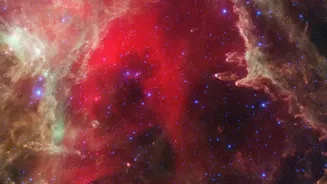
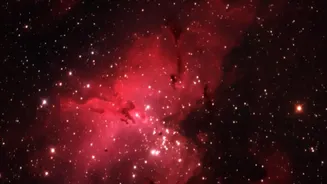
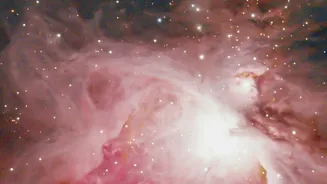
Stars form from the collapse of enormous clouds of gas and dust. The most widely accepted theory for binary star formation is called 'turbulent fragmentation'. As a vast cloud collapses under its own gravity, it doesn't do so uniformly. Instead, it breaks into multiple dense clumps. These individual clumps can then independently continue to collapse and ignite into separate stars. If two of these nascent stars, known as protostars, are close enough, their mutual gravitational pull will lock them into orbit around each other, creating a binary system from the very beginning. This process is more common than a star later capturing another in its orbit, which is a much rarer event.
A Celestial Identification Guide
Astronomers classify binary stars based on how they are detected. 'Visual binaries' are pairs that can be resolved into two distinct stars with a telescope. Sirius, the brightest star in our night sky, is a famous example, with a bright primary star and a faint white dwarf companion, Sirius B. 'Spectroscopic binaries' are detected by analysing their light; as the stars orbit, their light shifts towards the blue or red end of the spectrum due to the Doppler effect, revealing their motion. Finally, 'eclipsing binaries' are oriented in such a way that, from our perspective, one star periodically passes in front of the other, causing a temporary dip in brightness. The star Algol, known as the 'Demon Star', is a well-known eclipsing binary.
An Evolving and Dramatic Relationship
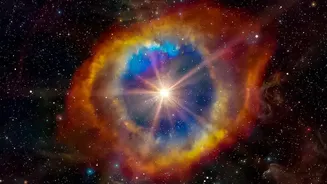
The lives of stars in a close binary system can be far more dramatic than those of single stars. If the stars are near each other, their immense gravity can distort their shapes and even pull material from one to the other. This process, called mass transfer, can drastically alter the evolution of both stars. It can cause a star to lose its outer layers, becoming a stripped-down core, while its companion gains mass and is spun up to rapid rotation. This stellar interaction is responsible for some of the most energetic and exotic phenomena in the universe, including certain types of supernovae and the formation of X-ray binaries.
Cosmic Laboratories
Binary systems are not just a cosmic curiosity; they are invaluable tools for astrophysics. By observing the orbits of two stars around a common center of mass, astronomers can directly calculate their individual masses—a fundamental property that is very difficult to measure for a solitary star. These mass measurements are critical for testing and refining theories of stellar structure and evolution. Essentially, binary stars provide a natural laboratory for understanding the life cycles of stars, from their formation in dusty nebulae to their often-violent end stages as white dwarfs, neutron stars, or black holes.