


Seeing the Universe in Infrared
While telescopes like the Hubble Space Telescope have given us stunning views of the cosmos primarily in visible light—the same light our eyes can see—the JWST is designed to see the universe in infrared. Infrared is a type of light beyond the red end
of the spectrum, which we perceive as heat. By focusing on this invisible light, JWST can uncover cosmic secrets that are otherwise completely hidden. There are two main reasons why this is a game-changer for astronomy. Firstly, many of the most interesting objects in the universe, such as forming stars and planets, are shrouded in thick clouds of cosmic dust. Visible light gets blocked by this dust, much like car headlights in a thick fog. But infrared light, with its longer wavelengths, can pass through these dusty veils, allowing us to see what’s happening inside.
Peering Inside Stellar Nurseries
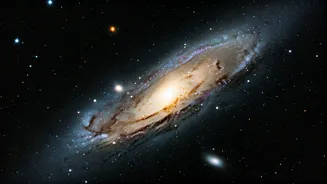
A perfect example of JWST's power is its view of the Pillars of Creation, a famous star-forming region in the Eagle Nebula. In Hubble's visible-light images, the pillars appear as dark, opaque columns of gas and dust. But when JWST aimed its infrared gaze at them, the pillars became semi-transparent, revealing countless newborn stars that were previously hidden within. These images show bright red and orange spheres—young stars bursting into existence. By penetrating these dusty cocoons, astronomers can study the earliest stages of star and planet formation in unprecedented detail. This isn't just about getting a clearer picture; it’s about witnessing the very processes that led to the formation of our own Sun and Earth billions of years ago. Recent observations of the starburst galaxy Messier 82, also known as the Cigar Galaxy, further highlight this capability, revealing millions of stars that were previously obscured.
A Time Machine to the Early Universe
The second reason infrared vision is so crucial is that it allows JWST to act as a cosmic time machine. The universe has been expanding ever since the Big Bang. As light from the most distant, and therefore earliest, galaxies travels across billions of light-years to reach us, its wavelength gets stretched out by this expansion. This phenomenon, known as 'redshift', shifts the light from the first stars and galaxies from visible or ultraviolet light into the infrared spectrum. Hubble could see back to about a billion years after the Big Bang, but the light from anything earlier was too redshifted for it to see clearly. JWST, with its massive mirror and specialized infrared instruments, can capture this faint, ancient light. This allows it to see galaxies that formed just a few hundred million years after the Big Bang, giving us our first-ever look at the cosmic dawn.
Uncovering New Cosmic Mysteries
By observing what was previously unobservable, JWST is not just confirming old theories but also uncovering entirely new questions. Its ability to analyze the chemical composition of distant worlds by looking at how their atmospheres absorb infrared light is a key part of this. For instance, recent analysis of data from Pluto and Saturn's moon Titan revealed a mysterious absorption of a specific wavelength of light, suggesting the presence of an unknown molecule not seen anywhere else. Furthermore, JWST has detected galaxies so massive and mature in the early universe that they challenge existing models of galaxy formation. These 'impossible' galaxies, full of mature red stars, appeared just 500 to 700 million years after the Big Bang, far earlier than scientists thought was possible. Each new observation provides another piece of the puzzle, sometimes changing our understanding of the entire picture.