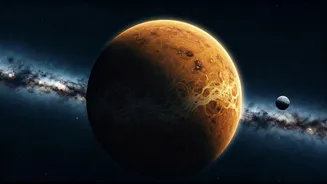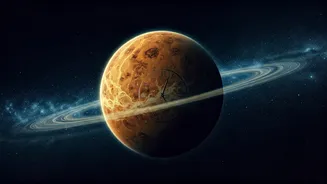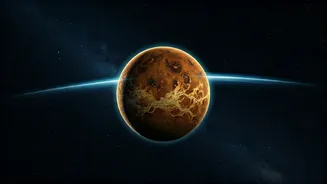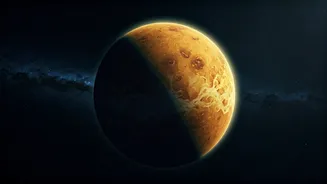





First, Let’s Define Time
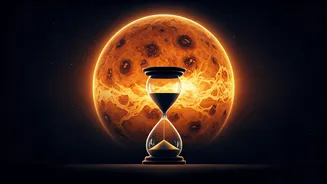
Before we dive into the weirdness of Venus, let's quickly recap how we measure time on any planet. A 'year' is the time it takes for a planet to complete one full orbit around the Sun. For Earth, that's roughly 365 days. A 'day' is the time it takes for a planet to complete one full rotation
on its own axis. For Earth, that’s about 24 hours. These two motions—orbiting and spinning—are independent of each other. On Earth, we are used to having many, many days within a single year. But the cosmos doesn't require this to be the rule. On Venus, the relationship between these two time scales is completely upended, making it one of the most peculiar places in our cosmic neighbourhood.
Venus by the Numbers
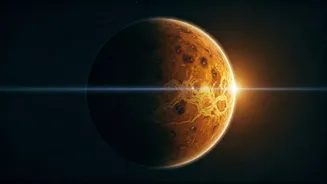
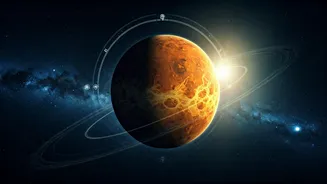
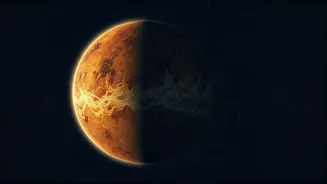
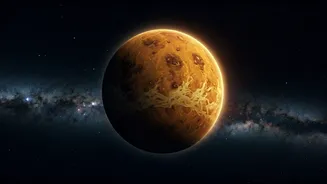
Here's where it gets truly mind-bending. A year on Venus—one full trip around the Sun—takes approximately 225 Earth days. This is its orbital period. Now, for the day. A single day on Venus, measured as one full rotation on its axis (a sidereal day), takes a staggering 243 Earth days. Let that sink in: it takes longer for Venus to spin once on its axis than it does for it to complete its entire journey around the Sun. This means if you were standing on Venus, you would experience an entire year pass by before a single day is technically over. It's a fundamental fact that highlights just how alien other worlds can be.
The Slow, Backward Spin
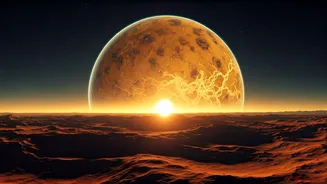
Venus's rotation is strange for two reasons. Firstly, it is incredibly slow. While Earth zips around on its axis, completing a rotation in 24 hours, Venus crawls along at a pace that makes its day longer than its year. Secondly, it spins in the opposite direction to most other planets in our solar system, including Earth. This is known as retrograde rotation. On Earth, the Sun rises in the east and sets in the west. On Venus, it’s the opposite: the Sun rises in the west and sets in the east. This backward spin is a crucial piece of the puzzle. Only Venus and Uranus exhibit this peculiar retrograde motion, setting them apart from the other planets which all spin prograde (in the same direction as their orbit).
The Sunrise-to-Sunrise Paradox
To add another layer of complexity, the 'day' we've been discussing (the 243 Earth-day rotation) is the sidereal day. However, what we might care about more is the solar day—the time from one sunrise to the next. Because Venus is spinning backwards as it orbits the Sun, these two motions work against each other in a unique way. The result is that a solar day on Venus is actually 'shorter' than its sidereal day, lasting about 117 Earth days. This means you’d have to wait nearly four Earth months for the Sun to return to the same spot in the sky. So, while a single spin takes 243 days, you’d experience roughly two sunrises (and two sunsets) in a single Venusian year.
Why is Venus So Weird?
Scientists don't have a definitive answer for Venus's slow, backward spin, but there are a few leading theories. One popular hypothesis suggests that in the early, chaotic days of the solar system, Venus was struck by a massive planet-sized object. This colossal impact could have been powerful enough to not only slow its rotation to a crawl but also knock it over, effectively reversing its spin direction. Another theory points to Venus's incredibly thick and heavy atmosphere. The dense carbon dioxide atmosphere, 90 times more massive than Earth's, creates immense thermal tides. Over billions of years, the gravitational pull of the Sun on this dense, sloshing atmosphere could have acted as a brake, slowing down the planet's rotation and eventually flipping it into a stable retrograde state.
A Portrait of an Inhospitable World
This bizarre timekeeping is just one feature of Venus's hostile environment. Often called Earth's 'evil twin' due to its similar size and mass, the planet is anything but hospitable. Its surface temperature is a scorching 465°C, hot enough to melt lead. The atmospheric pressure is equivalent to being 900 meters deep in Earth's ocean, a crushing force that would destroy any spacecraft not specifically designed to withstand it. Add clouds of sulfuric acid, and you have a vision of a truly hellish world. The long days and nights contribute to this extreme climate, with the surface baking for months under the Sun before plunging into a long, equally hot night.