
The Power of a Daily Habit
The secret to unlocking lasting flexibility isn't the duration of your yoga session, but its frequency. A consistent, daily practice of even 15-20 minutes allows your muscles and connective tissues to adapt and lengthen gradually. This approach is more
effective than a single, intense weekly class because it creates a continuous dialogue with your body, gently encouraging an increased range of motion over time. By making yoga a small part of your daily routine, you signal to your body that mobility is a priority, which helps prevent the stiffness that comes from prolonged sitting or inactivity. Think of it as daily maintenance for your overall health and well-being.
What Is a Yoga 'Flow'?
The term 'flow' in yoga refers to the practice of linking a series of poses, or 'asanas', together in a smooth sequence, often synchronizing each movement with your breath. This style, also known as vinyasa, is particularly effective for building flexibility because it warms up the body and muscles, making them more pliable. Instead of holding a single stretch for a long time, the continuous movement encourages your joints and muscles to open up dynamically. The breath is a key component; inhaling often corresponds with an upward or opening movement, while exhaling is paired with a downward or folding movement. This mindful breathing helps calm the nervous system and allows you to move deeper into the stretches safely.
Cat-Cow Pose (Marjaryasana-Bitilasana)
This is the perfect warm-up for the spine. Start on your hands and knees, with your wrists directly under your shoulders and your knees under your hips. As you inhale, drop your belly towards the mat, lift your chest and tailbone, and look forward into Cow Pose. As you exhale, round your spine toward the ceiling, tuck your chin to your chest, and press the mat away from you into Cat Pose. Repeat this movement for 5-10 breath cycles. This gentle flow increases spinal mobility, warms up the back muscles, and helps relieve tension in the neck and shoulders.
Downward-Facing Dog (Adho Mukha Svanasana)
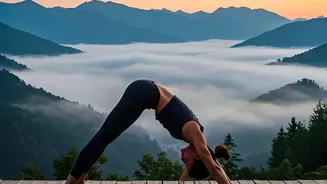
Perhaps the most recognized yoga pose, Downward-Facing Dog is a fantastic full-body stretch. From your hands and knees, tuck your toes, lift your hips up, and press them back to form an inverted 'V' shape with your body. Spread your fingers wide and press firmly through your palms. It's more important to keep your spine long than to get your heels to the floor, so feel free to keep a generous bend in your knees, especially if you have tight hamstrings. This pose stretches the hamstrings, calves, and shoulders while strengthening the arms and upper body.
Low Lunge (Anjaneyasana)
From Downward-Facing Dog, step your right foot forward between your hands. Lower your left knee to the mat, ensuring your right knee is stacked directly over your right ankle. You can place your hands on your front thigh or raise them overhead for a deeper stretch. You should feel a stretch along the front of your left hip and thigh (the hip flexor), an area that often becomes tight from sitting. Hold for 5-8 breaths before returning to Downward-Facing Dog and repeating on the other side.
Standing Forward Fold (Uttanasana)
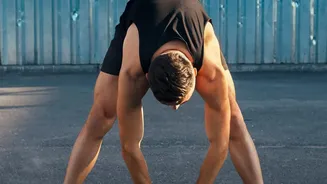
Stand with your feet hip-width apart. With a slight bend in your knees, exhale and hinge forward from your hips, letting your head and hands hang heavily toward the floor. You can let your arms dangle or gently hold opposite elbows. This pose is excellent for lengthening the hamstrings and decompressing the spine. Remember to bend at your hips rather than your lower back. To release, bend your knees and slowly roll up to standing one vertebra at a time.
Child's Pose (Balasana)
Child's Pose is a restorative posture perfect for ending your flow. Kneel on the mat, touch your big toes together, and sit back on your heels. Fold forward, resting your torso on your thighs and your forehead on the floor. Your arms can be stretched out in front of you or rested alongside your body. This pose gently stretches the lower back, hips, and ankles. It also calms the mind and relieves stress, making it a perfect way to conclude your practice.