


A Sweet Discovery in Deep Space
In a vast, swirling cloud of gas and dust thousands of light-years away, astronomers have detected something remarkable: a type of sugar called erythrulose. This isn't the kind of sugar you stir into your morning chai, but it's a crucial piece of a much
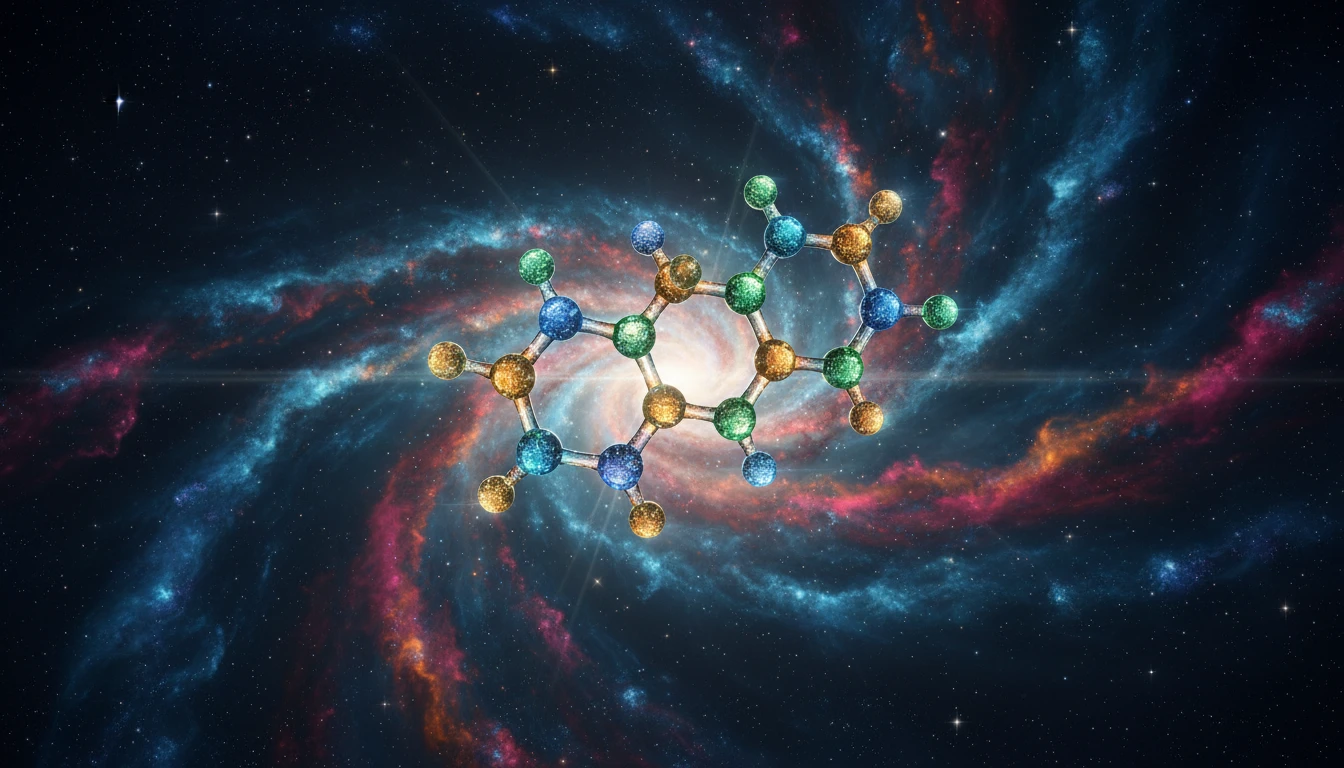
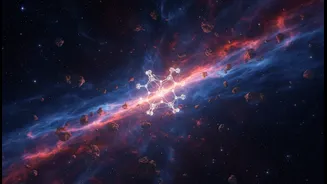
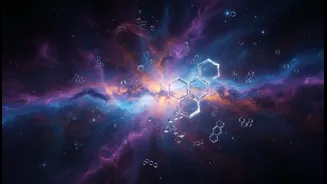
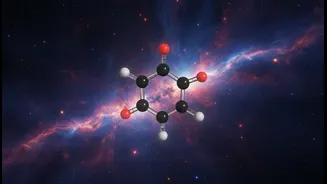
larger puzzle. Found on Earth in fruits like raspberries, erythrulose is a four-carbon sugar, a more complex structure than many of the simpler molecules previously found in interstellar space. The discovery was made by pointing powerful radio telescopes in Spain towards a molecular cloud near the galaxy's core, an area known to be a rich chemical factory. By matching the faint signals from space to the unique 'fingerprint' of the molecule in the lab, scientists confirmed its presence, marking the first time a true sugar has been directly detected in the interstellar medium.
The Galaxy's Chemical Kitchen
The centre of our galaxy is a chaotic and energetic place, but it's also a surprisingly fertile ground for complex chemistry. Giant clouds of dust and gas, like the one named G+0.693-0.027 where erythrulose was found, act as cosmic kitchens. Here, temperatures can be incredibly cold, allowing simple atoms to stick to icy dust grains. Over millions of years, these atoms combine to form larger and more intricate molecules. Previously, scientists had found simpler molecules like glycolaldehyde (a two-carbon sugar-like molecule) and even the building blocks of amino acids in these regions. However, the detection of erythrulose, a larger 14-atom molecule, was unexpected. It challenges the idea that complex molecules only form one carbon atom at a time, suggesting that chemistry in these interstellar nurseries might be more advanced than we thought.
Redefining the Primordial Soup
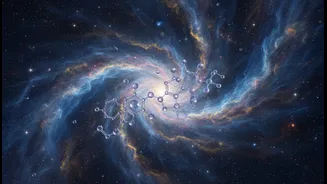
This is where the term 'chemical matrix' comes in. Think of it as the starter kit for a new planet. As a solar system forms, it gathers material from the surrounding molecular cloud. This material—the dust and gas—forms the planet itself and everything on it. For decades, scientists have debated how the building blocks of life, like sugars and amino acids, first appeared on Earth. Lab experiments trying to create these molecules under early Earth conditions have struggled to produce them in sufficient quantities. The discovery of erythrulose in space provides a compelling alternative. It suggests that these vital ingredients weren't necessarily made on Earth, but were instead delivered here. These molecules could have formed in space long before our planet even existed and arrived via comets and asteroids during a period known as the Late Heavy Bombardment.
A New Recipe for Life
The presence of erythrulose is particularly exciting because sugars are fundamental to life as we know it. They form the structural backbone of RNA and DNA, the molecules that store our genetic information. While erythrulose itself isn't used in DNA, it belongs to the same chemical family and its existence hints that its more famous cousin, ribose (the 'R' in RNA), could also be forming out there. If complex sugars are readily available in the clouds where stars and planets are born, it means the raw materials for life might be seeded onto newly forming planets from the very beginning. This significantly changes our understanding of prebiotic chemistry. It moves the starting line for life from the surface of a young planet to the cold, dark clouds floating between the stars, potentially making the universe a much more life-friendly place.