



The Grand Challenge of Robotic Touch
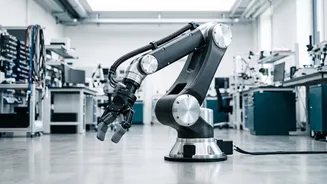
Industrial robots are powerful and precise, but their utility has long been limited by a fundamental weakness: a lack of dexterity. Welding a car frame or lifting a heavy pallet is easy for a machine programmed for one specific action. But ask that same
robot to pick a single strawberry from a pile without crushing it, handle a flimsy plastic bag, or insert a delicate wire, and the system often fails. This is the 'long-tail' problem of robotics, where handling an endless variety of shapes, weights, and materials in unstructured environments has remained a profound challenge. A human worker instinctively knows how to adjust their grip for an egg versus a brick, but for a robot, this requires a complex blend of perception, judgment, and feedback that has been incredibly difficult to replicate. This limitation has kept automation out of countless tasks in logistics, food processing, and electronics assembly, where the objects are simply too varied or fragile for 'blind' robots to manage.
Eka's Vision-Force-Action Model
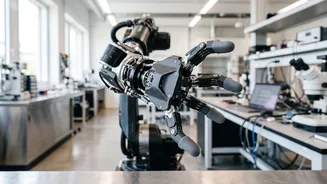
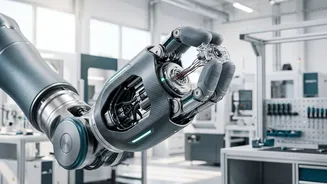
Eka Robotics, a startup founded by experts from MIT and Google DeepMind, is tackling this problem with a novel approach it calls a Vision-Force-Action (VFA) model. Instead of just relying on cameras (vision) to see an object, Eka's system integrates force-sensing technology into its custom grippers. This gives the robot a sense of 'touch', allowing it to feel how an object is responding to its grasp in real-time. If an item starts to slip, the robot can feel the change in pressure and adjust its grip, much like a person would. This combination of seeing and feeling solves what is known as the 'last millimeter problem', where the final act of making contact and securing a grip is often the most critical and failure-prone part of the process.
Learning from Physics, Not Just Mimicry
Another key differentiator for Eka is how its AI learns. Many robotic systems are trained by watching human demonstrations. Eka, however, believes that for robots to achieve superhuman performance, they must master physics, not just mimic people. The company uses advanced physics simulators to train its VFA model. In these virtual environments, the AI can run through thousands of hours of trial-and-error experience in just minutes, learning how different objects behave under various forces and conditions. This reinforcement learning at a massive scale allows the AI to build a genuine 'intuition' for physical interactions. When this learned intelligence is transferred from the simulation to the real-world robot, it can handle objects it has never seen before with remarkable success, because it understands the underlying principles of how to grasp things, rather than just remembering a specific shape.
Superhuman Speed and Real-World Applications
The results of Eka's approach are impressive. The company reports its robots can pick and place a wide variety of objects at a speed of 1,500 items per hour, with over 95% accuracy. This is roughly two and a half times faster than the average human baseline of about 600 items per hour. The same robot that can sort objects at high speed has also demonstrated the ability to perform more intricate tasks like screwing in a lightbulb or inserting wires. This level of versatile performance opens up automation to a vast range of industries. Potential applications include e-commerce warehouses for fulfilling orders with diverse products, food production for handling delicate produce like fruit, and electronics manufacturing for assembling complex components. By solving the dexterity problem, Eka aims to automate trillions of dollars' worth of physical tasks that still depend on human hands.
The Road Ahead for Dexterous Robots
Having recently secured $150 million in Series A funding at a valuation of over $1.4 billion, Eka Robotics is well-capitalized to scale its technology and begin customer deployments. The investment, led by prominent venture capital firms, signals strong market confidence that Eka's physical AI model is nearing commercial viability. The next critical step is to prove that this performance holds up not just in demonstrations but in real-world industrial settings, running reliably through full production shifts. As India's manufacturing sector continues its rapid push toward automation—with robot installations growing at a compound annual rate of 27% between 2020 and 2025—technologies like Eka's are poised to play a crucial role. By enabling automation for tasks that were previously out of reach, this new generation of dexterous robots could significantly boost efficiency, quality, and competitiveness for Indian industries on the global stage.