





A Journey to the Solar System's Edge
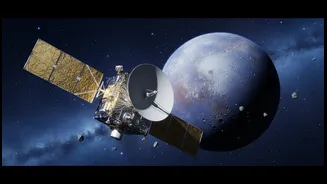
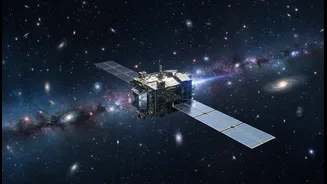
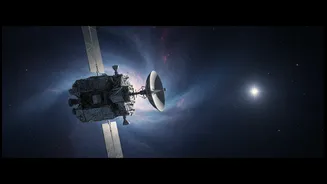
Launched in January 2006, New Horizons was the fastest spacecraft ever to leave Earth, a necessity for its nine-and-a-half-year journey to Pluto. It's a compact probe, about the size of a grand piano, packed with seven highly advanced scientific instruments
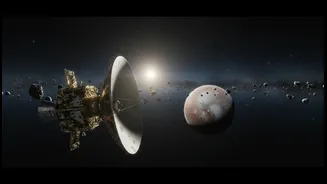
designed for a long and lonely voyage. After a gravity-assist flyby of Jupiter in 2007 that shaved three years off its travel time, the spacecraft spent much of the next eight years in hibernation. On July 14, 2015, it made history, becoming the first mission to conduct a close-up reconnaissance of the Pluto system, a relic from the formation of our solar system. The entire flyby, during which it gathered an unprecedented 5,000 times more data than the Mariner missions did at Mars, was an automated and breathtakingly fast encounter.
Rewriting the Book on Pluto
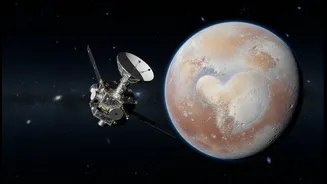
Before New Horizons, Pluto was little more than a fuzzy pixel in our most powerful telescopes. The 2015 flyby revealed it to be a stunningly complex and active world. Perhaps the most iconic discovery was a vast, heart-shaped nitrogen glacier on its surface, named Sputnik Planitia, which is the largest known glacier in the solar system. Images showed towering mountains made of water ice, a hazy blue atmosphere, and signs that Pluto might have had liquid on its surface in the past, with hints of a subsurface water-ice ocean today. The encounter fundamentally changed our view of dwarf planets, showing that even small, cold worlds at the far reaches of the solar system can have rich geological histories. Data also revealed Pluto's largest moon, Charon, to have its own dramatic features, including a massive tectonic belt suggesting a long-dead internal ocean.
Beyond Pluto: A Visit to Arrokoth
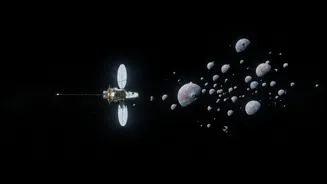
After its triumph at Pluto, the mission was extended. On January 1, 2019, New Horizons flew past Arrokoth, a small object in the Kuiper Belt, a vast ring of icy bodies beyond Neptune. This made Arrokoth the most distant and primitive object ever explored by a spacecraft. Its peculiar, snowman-like shape—formed from two separate spheres that gently merged—provided a crucial clue about how planets form. The data suggested that the building blocks of planets, or planetesimals, came together not through violent collisions, as one long-held theory suggested, but through a slow, gentle accretion. Arrokoth is a perfectly preserved relic from the dawn of the solar system, offering a window into the conditions of its birth some 4.5 billion years ago.
Why It Matters on Earth
Missions like New Horizons are not just about spectacular images. The technological challenges of sending a probe billions of kilometres away spur innovation. The mission advanced the miniaturisation of scientific instruments and improved deep-space communication techniques, including a novel "uplink" radio experiment. Furthermore, studying the Kuiper Belt has direct relevance to understanding our own planet. Scientists believe that objects kicked out of this region and sent toward the inner solar system may have delivered water and other organic ingredients essential for the origin of life on Earth. More broadly, the mission serves as a powerful source of inspiration, encouraging public interest in science and motivating the next generation of engineers, scientists, and explorers.
The Unfinished Journey and Remaining Questions
Even today, New Horizons continues its journey deeper into space. In mid-2026, the spacecraft woke from a nearly year-long hibernation and began transmitting data from its lonely post almost 9.5 billion kilometres from Earth. While another flyby of a distant object isn't currently planned, the mission has shifted its focus. It now acts as a unique observatory in the outer heliosphere, studying the region where the Sun's influence wanes and interstellar space begins. Scientists are using its instruments to study hydrogen gas distribution and the dust environment, collecting data from a region no other active mission is exploring. Key questions remain: How did Pluto get its heart? What other secrets do pristine Kuiper Belt objects hold? And what happens at the true edge of our solar system? New Horizons will continue to help us find the answers.