




A Cold, Dark Treasure
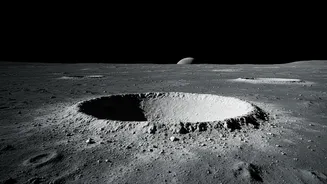
At the Moon's poles lie craters that haven't seen sunlight in billions of years. These permanently shadowed regions (PSRs) are incredibly cold, acting as celestial freezers. Inside, scientists believe, are vast deposits of water ice. This ice is more
than just frozen water; it's a potential scientific and economic game-changer. For scientists, the ice is a time capsule, possibly containing clues about the formation of our solar system and the origins of life on Earth. For the burgeoning space economy, this ice represents a vital resource. It can be broken down into hydrogen and oxygen for breathable air and, more importantly, rocket propellant. A refueling station on the Moon could make missions to Mars and beyond significantly cheaper and more feasible.
The Rules of the Cosmic Road
This is where 'planetary protection' comes in. It’s not about fending off alien invasions. It's a set of principles designed to prevent us from contaminating other worlds with Earth-based microbes (forward contamination) and, conversely, protecting Earth from any potential extraterrestrial organisms on returning missions (backward contamination). These guidelines are stewarded by the international Committee on Space Research (COSPAR), upholding the spirit of the 1967 Outer Space Treaty. The goal is to preserve the scientific integrity of these pristine environments until they can be studied in detail.
An Unseen, Global Threat
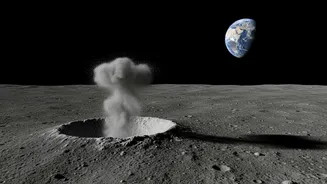
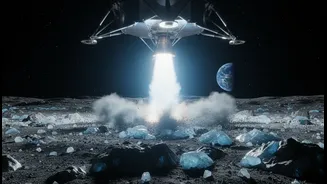
The new lunar rush has put these principles under strain. The problem is rocket exhaust. When a lander fires its engines to touch down, it releases a plume of gases, including water vapor and other chemicals like methane. On Earth, our thick atmosphere would contain this. But in the Moon's near-vacuum, these hot gas molecules travel on ballistic trajectories, essentially 'hopping' across the lunar surface. Recent studies and computer simulations show that exhaust from a single landing can spread globally in mere hours. A significant portion of this exhaust eventually finds its way to the ultra-cold polar craters, where it freezes and sticks, potentially for a very long time.
The Scientific Dilemma
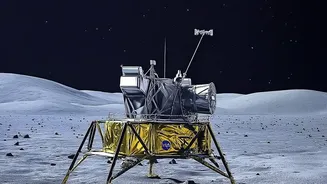
This creates a profound dilemma. We are sending missions, like those under NASA's Artemis program and a host of commercial landers, to study and eventually use this ice. Yet, the exhaust from these landers could deposit a layer of artificial water and other chemicals over the ancient, natural ice. This would be like trying to read a 4-billion-year-old manuscript after someone has sprayed it with graffiti. Scientists wouldn't know if the molecules they were analyzing were pristine relics from the early solar system or just residue from the rocket that brought their instruments. The very act of exploration threatens to corrupt the data we seek to collect. Even worse, some studies suggest that these cold, dark craters could be protective environments for any Earth microbes that accidentally hitch a ride, where they could survive for extended periods.
A Crowded Frontier Demands New Rules
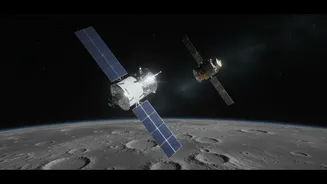
This isn't a theoretical problem for the distant future; it's happening now. A new wave of robotic and, soon, human missions from multiple nations and private companies are all targeting the lunar south pole. This influx of activity has put planetary protection in the spotlight, forcing a debate about whether the existing rules are sufficient for this new, commercially driven era of space exploration. The challenge is to balance the drive for progress and resource utilization with the responsibility of scientific preservation. The discussion is no longer confined to scientists; it involves engineers, policymakers, and the executives of companies planning lunar ventures. Some have called for mission planners to actively monitor and model their exhaust plumes as a routine part of development.