







Why Just Five Minutes Matters
It may not sound like much, but dedicating just five minutes to intentional breathing can have a profound impact on your well-being. Studies show that controlled breathing exercises can lower stress hormones like cortisol, slow your heart rate, and reduce
blood pressure. This practice activates the body's 'rest and digest' system, also known as the parasympathetic nervous system, signalling to your brain that it's safe to relax. It’s a powerful way to interrupt the 'fight-or-flight' response that so often gets triggered by daily pressures, improving your mood and ability to focus.
The Foundation: Diaphragmatic (Belly) Breathing
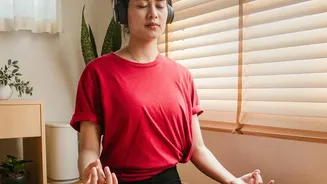
Before diving into specific workouts, it helps to master the basics of diaphragmatic breathing, or 'belly breathing'. Many of us breathe shallowly from our chests, especially when stressed. Diaphragmatic breathing is a deeper, more efficient way to breathe that fully engages the main muscle of respiration. To practice, sit or lie down comfortably. Place one hand on your chest and the other on your belly. Inhale slowly through your nose, focusing on letting your belly expand with air while your chest remains relatively still. Exhale slowly through your mouth. This technique ensures you are taking full, deep breaths, which is the cornerstone of all mindful breathing exercises.
Workout 1: Box Breathing for Focus
Used by everyone from athletes to Navy SEALs, box breathing is an excellent technique for calming nerves and sharpening focus. Its simplicity makes it easy to do anywhere, from your office chair to a queue at the grocery store. The structure is based on a count of four, creating a mental 'box'. To begin, find a comfortable seated position. 1. Slowly exhale all the air from your lungs. 2. Inhale quietly through your nose for a count of four. 3. Hold your breath for a count of four. 4. Exhale slowly through your mouth for a count of four. 5. Hold your breath again for a count of four before repeating the cycle. Continue this pattern for five minutes. The steady, even rhythm has a powerful regulating effect on your nervous system.
Workout 2: The 4-7-8 Breath for Relaxation
Developed by Dr. Andrew Weil, the 4-7-8 breathing technique is often called a 'natural tranquilizer for the nervous system'. It's particularly effective for easing anxiety and promoting sleep. The key is the extended exhale, which helps to slow the heart rate significantly. To practice, sit with your back straight and place the tip of your tongue on the tissue ridge just behind your top front teeth. Keep it there for the entire exercise. 1. Exhale completely through your mouth, making a 'whoosh' sound. 2. Close your mouth and inhale quietly through your nose for a mental count of four. 3. Hold your breath for a count of seven. 4. Exhale completely through your mouth, making a 'whoosh' sound, for a count of eight. This completes one cycle. In the beginning, aim to complete four cycles in a row. You can work your way up to eight cycles as you get more comfortable.
Workout 3: Cyclic Sighing to Shed Stress
Recent research from Stanford University has highlighted cyclic sighing as a particularly effective way to improve mood and reduce anxiety. This technique involves a double inhale followed by a long exhale, mimicking the body's natural sighing pattern used to release tension. To try it, sit or lie down comfortably. 1. Inhale through your nose to comfortably fill your lungs. 2. Once your lungs feel full, take another short, sharp inhale to expand them completely. 3. Then, exhale as slowly and completely as possible through your mouth. Repeating this for just a few minutes can create a noticeable sense of calm. The extended exhale is key to activating the body's relaxation response.
Making It a Daily Habit
The greatest benefits of these breathing workouts come from consistency. Like any form of exercise, the more you practice, the more natural and effective it becomes. Start by choosing one technique that resonates with you. Try 'habit stacking' by linking your five-minute breathing session to an existing daily routine, such as right after you brush your teeth in the morning or before you turn on your computer for work. You can also use these techniques as an in-the-moment tool whenever you feel stress levels rising. The goal is not to be perfect, but simply to show up for yourself for five minutes each day.