
The Sun's Final Chapters
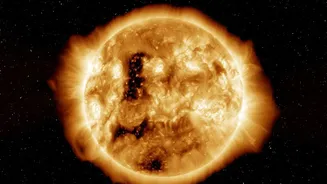
Like all stars, the Sun is powered by nuclear fusion, turning hydrogen into helium in its core. This process has been stable for about 4.6 billion years, but the fuel won't last forever. When the hydrogen runs out in roughly five billion years, gravity
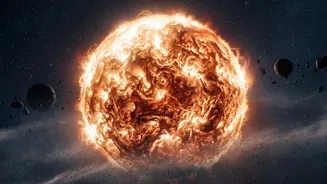
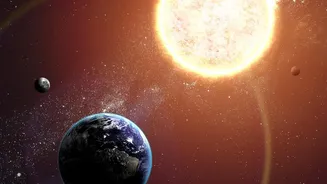
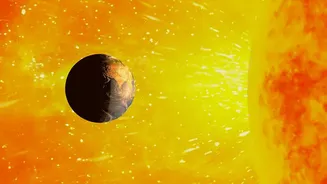
will cause the core to contract and heat up. This will trigger a new phase of fusion in a shell surrounding the core, causing the Sun's outer layers to expand dramatically. It will swell into a 'red giant', becoming over 200 times its current size, and in the process, it is expected to engulf Mercury and Venus, and possibly Earth. This red giant phase will last for about a billion years before the next stage begins.
What Is Stellar Mass Loss?
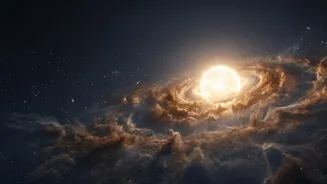
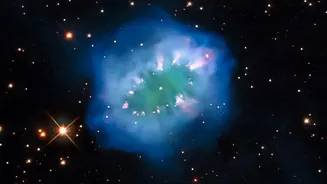
As stars like our Sun enter their final stages, they become unstable. The journey from a red giant to its final state as a compact 'white dwarf' involves shedding its vast outer layers of gas and dust. This process is known as stellar mass loss. This ejected material, known as the star's envelope, can account for up to half of the star's total mass. For a time, this cloud of expelled gas and dust is illuminated by the hot, exposed core of the dead star, creating a spectacular, glowing structure called a planetary nebula. These nebulae, despite their name, have nothing to do with planets but are crucial for enriching the galaxy with heavier elements necessary for forming new stars and planets.
The 'Smooth' Model: A Slow Fade
For a long time, the prevailing theory was that the Sun would lose mass in a relatively calm and steady manner. This 'smooth' mass loss model pictures a consistent stellar wind carrying away the Sun's outer atmosphere over a long period. Think of it like a slowly deflating balloon. In this scenario, as the Sun’s mass gradually decreases, its gravitational pull on the outer planets weakens. This would cause Jupiter, Saturn, Uranus, and Neptune to gently drift into wider, but still stable, orbits. Under this model, the outer solar system could remain intact for an incredibly long time—perhaps hundreds of billions of years—until a passing star eventually disrupts it.
The 'Bursty' Model: A Violent Finale
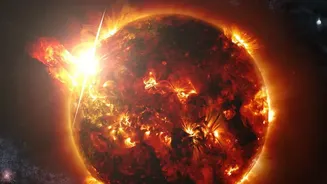
However, more recent and sophisticated models suggest a far more chaotic end. Instead of a smooth, continuous wind, the Sun might shed its mass in a series of violent, episodic ejections or 'bursts'. This 'bursty' or bumpy mass loss is linked to instabilities in the aging star, such as thermal pulses from its helium-burning shell, which can cause it to pulsate and violently cast off large chunks of its envelope. This process would be more like a series of convulsive shudders than a gentle sigh. Each sudden burst would send a gravitational jolt through the solar system, kicking the planets' orbits around.
Why the Difference Is Critical
The distinction between smooth and bursty mass loss has profound implications for the fate of our solar system. A smooth process leads to a quiet, long-term stability for the outer planets. A bursty one, however, introduces chaos. Recent simulations published in late 2026 in The Astrophysical Journal Letters explored this very question. By modeling scenarios with episodic ejections, researchers found that the irregular 'shaking' of the solar system as the Sun sheds its mass would quickly destabilize the orbits of the giant planets. Rather than surviving for billions of years, the outer solar system could be torn apart in a fraction of that time.
A Chaotic End for the Outer Planets
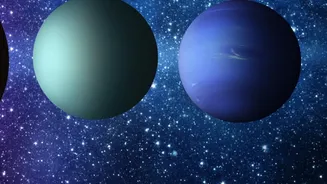
According to simulations that model this bursty mass loss, the end comes much faster. The timeline for the outer solar system's destruction shrinks from potentially a quintillion years down to just one billion years after the Sun becomes a white dwarf. In up to 96% of these more violent scenarios, the planetary system becomes unstable. The outcomes are dramatic, with simulations showing planets being ejected from the solar system entirely or giant planets like Uranus and Neptune swapping orbits before being scattered. This new research suggests the Sun's death won't be a quiet event the planets survive, but the very trigger for their orbital undoing.