






The Junkyard in the Sky
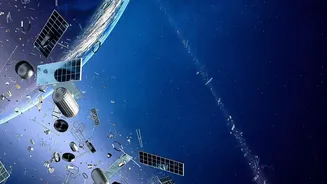
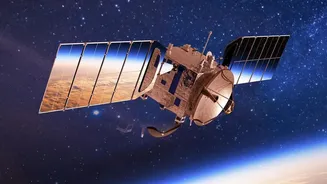
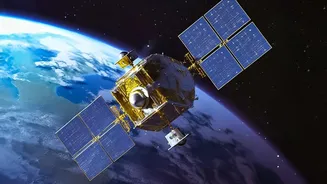
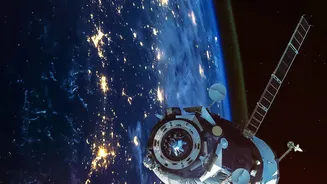
Low Earth Orbit (LEO) is an essential resource, enabling everything from GPS navigation and global communications to climate monitoring. However, decades of space activity have left a dangerous legacy. Thousands of non-operational satellites, spent rocket
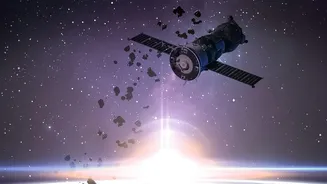
stages, and fragments from past collisions are currently circling the planet at incredible speeds. Traveling at up to 17,500 miles per hour, even a small piece of debris can strike an active satellite with devastating force. This growing cloud of junk raises the frightening possibility of the Kessler Syndrome, a theoretical cascade where collisions create more debris, which in turn leads to more collisions, potentially rendering entire orbits unusable for generations. This threat is no longer purely academic; several collisions have already occurred, and the rapid deployment of mega-constellations is increasing the urgency to find a solution.
An Elegant Solution: The Electrodynamic Tether
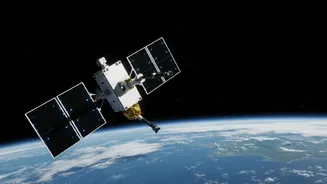
Instead of using precious fuel to push a dead satellite into a lower orbit, imagine it being gently pulled down by a long, super-strong wire. This is the core concept behind the electrodynamic tether (EDT). An EDT is not just any cable; it is a long, conductive wire, often made of a material like aluminum and stretching for a kilometer or more. When attached to a satellite, it can de-orbit the spacecraft without requiring any propellant. This makes it a lightweight, cost-effective, and passive solution for end-of-life satellite disposal. Several companies and space agencies, including those in Europe and Japan, are actively developing and testing these systems as a key technology for mitigating the growth of space debris.
How Physics Does the Heavy Lifting
The magic behind the magnetic tether lies in fundamental physics. As a conductive tether moves through Earth's magnetic field at orbital speeds, it generates an electric voltage along its length, much like a power generator. This process creates an electric current that flows through the tether. This current then interacts with the planet's magnetic field to produce a force known as the Lorentz force. By controlling the direction of the current, this force can either boost a satellite to a higher orbit or, more importantly for this application, create drag. This electrodynamic drag acts like a brake, slowing the satellite down. The reduction in speed causes the satellite's orbit to decay, gradually pulling it lower until it re-enters Earth's atmosphere and burns up safely.
The Fuel-Free Advantage
The most significant advantage of an electrodynamic tether is that it is a propellant-less system. Conventional de-orbiting strategies require a satellite to reserve a portion of its fuel for a final de-orbit burn. This reserved fuel is dead weight for the satellite's entire operational life, increasing launch costs and taking up valuable mass that could have been used for scientific instruments or communication hardware. Because tethers generate drag by interacting with the environment, they offer a passive and highly efficient alternative. They are lightweight, compact, and can be designed to deploy automatically at the end of a satellite's mission, even if the main spacecraft has suffered a complete failure. This provides a reliable and mass-efficient way to comply with international guidelines that call for satellites to be removed from orbit within a set period after their mission ends.
From Theory to Orbital Test
Electrodynamic tethers are rapidly moving from theoretical models to real-world application. Various research missions have been launched to test deployment mechanisms and the efficiency of current generation in space. Projects led by NASA, the European Space Agency (ESA), and the Japanese Aerospace Exploration Agency (JAXA) have all contributed to maturing the technology. For example, the E.T.PACK project in Europe aims to develop a full de-orbit kit for satellites, with demonstration flights planned. Other missions have successfully demonstrated the deployment of tethers from small CubeSats. While challenges remain, such as ensuring the long tether doesn't get severed by micrometeoroids, the technology is considered one of the most promising solutions for tackling the space debris problem head-on.