







The Promise of the Perfect Location
In the cosmic real estate hunt, the habitable zone has long been the prime location. This is the orbital band around a star where temperatures are just right—not too hot, not too cold—for liquid water to exist on a planet's surface. With water being a key
ingredient for life as we know it, finding rocky, Earth-sized planets in this zone has been a primary goal for astronomers. Missions have discovered thousands of such exoplanets, raising hopes that we are closer than ever to answering the question: are we alone?
A Focus on Red Dwarfs
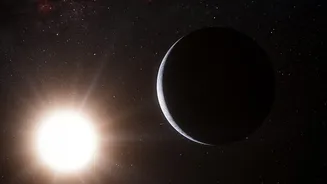
Many of these promising worlds orbit red dwarf stars. These stars are the most common type in our Milky Way galaxy, making up about 70% of the stellar population. They are smaller, cooler, and dimmer than our Sun. Because they are dimmer, their habitable zones are much closer to the star. This proximity makes it easier for astronomers to detect transiting planets, as the planets block a larger fraction of the star's light. Systems like TRAPPIST-1, with multiple Earth-sized planets in its habitable zone, have become focal points in the search for extraterrestrial life. However, this closeness comes with a significant and dangerous downside.
The Star's Violent Temperament
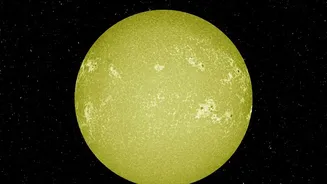
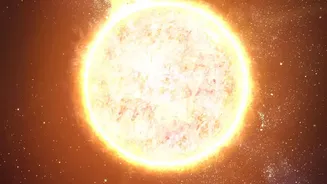
Red dwarfs are known for their violent and unpredictable nature, especially in their youth. They are magnetically active and can unleash powerful stellar flares and coronal mass ejections (CMEs). These events blast out high-energy radiation, including X-rays and extreme ultraviolet (XUV) light, along with streams of charged particles. While our own Sun has flares, the activity on many red dwarfs is far more frequent and intense. A single flare from a star like Proxima Centauri, our closest stellar neighbour, was observed to be 10 times brighter than the Sun's largest flares.
A Threat to Atmospheres and Life
For a planet orbiting closely, this stellar activity is catastrophic. The intense radiation and stellar wind can strip a planet's atmosphere away over time, a process called atmospheric erosion. Without a protective atmosphere, liquid water would boil away, and the surface would be exposed to sterilizing levels of radiation. Studies suggest that frequent, lower-energy flares can have a greater cumulative impact than less frequent, high-energy ones. The constant bombardment of XUV radiation can heat a planet's upper atmosphere, causing it to escape into space. This makes it incredibly difficult for planets like Proxima b or those in the TRAPPIST-1 system to hold onto the very air that could make them habitable.
A Glimmer of Hope?
Despite the risks, not all hope is lost. A planet's ability to withstand its star's fury depends on several factors. A strong global magnetic field, like Earth's, can act as a shield, deflecting the worst of the stellar wind. However, many of these close-orbiting planets are expected to be 'tidally locked,' with one side permanently facing the star, which could inhibit the generation of a strong magnetic field. Another possibility is that life could emerge underwater, shielded from surface radiation. Some research even suggests that some amount of UV radiation could be necessary to spark the chemical reactions that lead to life, creating a delicate balance between a creative and destructive force. Furthermore, studies have shown that some microorganisms can survive extreme UV radiation, suggesting life could adapt to harsh conditions.