






The Challenge of Shift Work Sleep
Working when the sun is down and sleeping when it's up goes against millions of years of human evolution. Our bodies are designed to follow a 24-hour cycle of light and darkness, known as the circadian rhythm. This internal clock tells us when to feel
alert and when to feel tired. For shift workers, this natural rhythm is constantly disrupted. Working under bright lights at night and then trying to sleep during the day confuses the body, leading to poor sleep quality, fatigue, and a higher risk of health issues. The journey home in the bright morning sun can be particularly disruptive, signaling to your brain that it's time to be awake right when you need to be winding down.
Understanding Your Body's Master Clock
Think of your circadian rhythm as a master clock located in your brain. Its primary job is to sync your body's internal processes with the 24-hour day. The most powerful signal for this clock is light. When light enters your eyes, it sends a message directly to your brain, essentially telling it the time of day. This is why you feel naturally energetic during the day and sleepy at night. This clock also controls the release of a crucial sleep hormone called melatonin. Often called the 'hormone of darkness,' melatonin levels rise in the evening to prepare your body for sleep and fall in the morning to help you wake up.
The Two Faces of Light
Not all light is created equal. The light from the midday sun is packed with blue wavelengths, which are excellent at suppressing melatonin and boosting alertness—perfect for a productive day. However, modern life means we are surrounded by artificial light, from our overhead bulbs to our phone screens, often late into the night. Most standard indoor lighting is cool and blue-rich, mimicking daylight. When your body is exposed to this kind of light in the hours before you intend to sleep, it sends a powerful 'wake up' signal to your brain, stopping melatonin production in its tracks. In contrast, the light from a sunset is warm, filled with red and orange hues. This type of light has a minimal effect on melatonin and signals to your body that it's time to wind down.
Creating Your Own Indoor Sunset
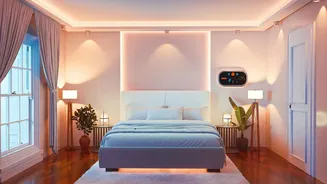
For a shift worker, creating an artificial sunset after a night shift is a powerful way to prepare the body for sleep. The goal is to switch from the blue-toned light that keeps you alert to warm-toned light that encourages rest. The colour temperature of light is measured in Kelvin (K). Cool, daytime light is typically 4000K and above, while the warm, calming glow of a sunset is below 3000K. For optimal sleep, experts recommend using bulbs with a color temperature of 2700K in the hours before bed. Many smart bulbs allow you to not only dim the brightness but also change the color temperature, making it easy to schedule a gradual shift from cool to warm light. If smart bulbs aren't an option, simply swapping your evening-time bulbs for ones labeled 'soft white' or 'warm white' (2700K-3000K) can make a significant difference.
A Practical Pre-Sleep Routine
To get the most out of your new lighting setup, build a routine around it. One to two hours before you plan to sleep, dim the lights and ensure they are all in that warm, sub-3000K range. This is also the time to put away phones, tablets, and computers, or at least use their 'night mode' settings to filter out blue light. If you commute home in the morning, consider wearing blue-blocking glasses to prevent the morning sun from suppressing your melatonin. The idea is to create a low-light, warm-hued sanctuary that tells your body it is nighttime, even if the sun is shining outside. By managing your light exposure with intention, you can help nudge your internal clock back into alignment and give yourself the best possible chance at a deep, restorative sleep.