



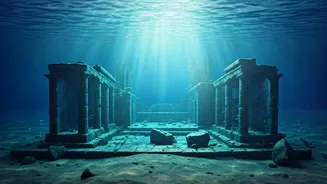
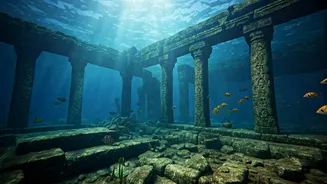


The Legend of the Lost Pagodas
The magnificent Shore Temple in Mahabalipuram, a UNESCO World Heritage site, stands as a proud sentinel on the coast of the Bay of Bengal. But for centuries, local lore and ancient mariners’ tales have spoken of it not as a solitary wonder, but as the last
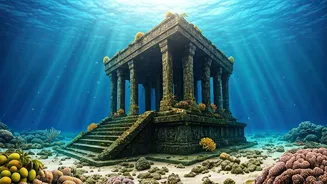
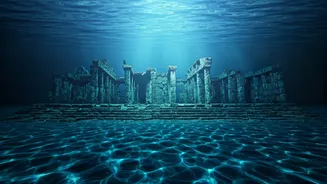
survivor of seven temples. The legend, passed down through generations, tells of a glorious city so beautiful that it invoked the jealousy of the gods, who unleashed the sea to swallow six of its magnificent pagodas. For a long time, these stories were dismissed as folklore—a romantic myth of a glittering city lost beneath the waves. European sailors since Marco Polo's time referred to the landmark as the 'Seven Pagodas', but with only one temple visible, the story remained a tantalizing mystery.
A Tsunami's Glimpse into the Past
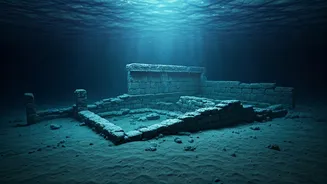
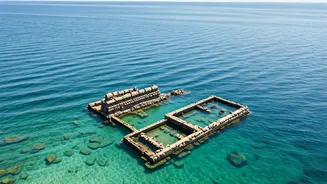
The legend was dramatically thrust back into the spotlight in December 2004. As the Indian Ocean tsunami pulled the sea back from the coastline, eyewitnesses for a fleeting moment saw a long row of large stone structures and submerged ruins emerge from the seabed before the waves crashed back over them. This incredible event, born from tragedy, gave powerful credence to the age-old stories. It wasn’t just a fleeting glimpse; the receding waters also permanently uncovered a large granite lion and other carved artefacts on the beach. This provided tangible, physical evidence that there was indeed more to Mahabalipuram’s history buried under the sand and sea, prompting a renewed and more vigorous scientific quest.
Science Dives into the Myth
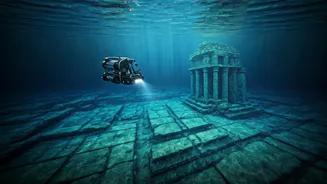
Even before the tsunami, explorations were underway. Since the early 2000s, joint teams from India's National Institute of Oceanography (NIO) and the Archaeological Survey of India (ASI) had been investigating the area. The post-tsunami discoveries, however, intensified these efforts. The primary tool for this underwater exploration is side-scan sonar. This technology works by sending out acoustic pulses from a device towed behind a boat. These pulses bounce off the seabed, creating a detailed map of the ocean floor. Hard objects, like stone walls, reflect the sound waves differently than sand or mud, showing up on the sonar imagery as distinct anomalies. This allows archaeologists to “see” the layout of what lies beneath meters of water and sediment without disturbing the site, pinpointing areas of interest for divers to explore further.
What the Sonar Has Revealed
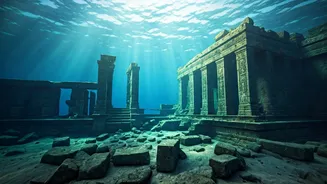
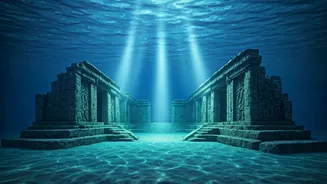
The results have been nothing short of astonishing, gradually turning myth into verifiable fact. Sonar mapping and subsequent dives have confirmed the presence of a significant submerged complex. At depths ranging from five to eight meters and stretching up to 800 meters from the current shoreline, researchers have found definitive man-made structures. These are not just random piles of rock; they are the remains of walls, some over 10 meters long, with distinct courses of masonry. They have also found paved platforms, flights of stairs leading to nowhere, and numerous dressed stone blocks bearing the marks of Pallava-era tools. The layout suggests a well-planned complex that was once part of the larger city. While archaeologists have not found six intact temples, they have proven that the Shore Temple was not alone, but part of a much larger settlement that was claimed by the sea over 1,500 years ago.