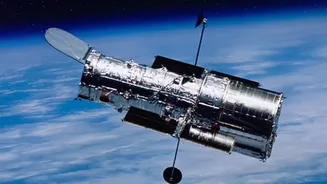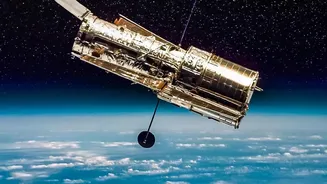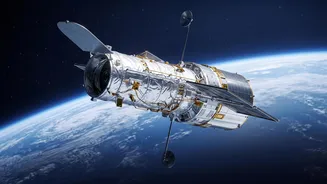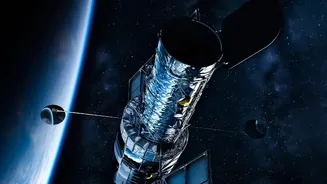







The legendary Hubble Space Telescope, our eye on the cosmos for over 35 years, is slowly falling. Now, NASA is turning to the private sector for a creative solution to boost it back into a stable orbit and extend its remarkable scientific legacy.
A Slow But Steady Descent
For more
than three decades, the Hubble Space Telescope has orbited Earth, capturing breathtaking images that have fundamentally changed our understanding of the universe. But its time is running out. Like all objects in low-Earth orbit, Hubble is subject to faint atmospheric drag, which causes its orbit to gradually decay. Without an onboard propulsion system to counteract this effect, the telescope's altitude is slowly decreasing. Projections indicate that without intervention, Hubble could make an uncontrolled reentry into Earth's atmosphere sometime in the mid-2030s. With its own Space Shuttle fleet retired, NASA can no longer perform the reboost missions that extended Hubble's life in the past.
A Call for Commercial Solutions
In response to this challenge, NASA issued a formal Request for Information (RFI) on October 29, 2026, inviting the commercial space industry to propose solutions. This is not a contract but a market research effort to understand what's possible with current and near-future technology. The agency outlined three main possibilities for which it is seeking ideas: a mission to reboost Hubble to a higher, more stable orbit of at least 600 kilometers; a servicing mission to potentially upgrade its systems; or a plan to safely guide the telescope to a controlled deorbit over the Pacific Ocean at the end of its life. Any proposed mission must not harm the historic observatory, and NASA hopes to see it completed by 2032.
New Era, New Partners
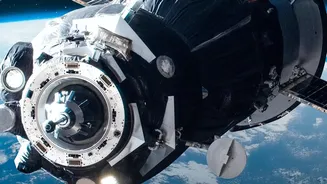
This isn't the first time NASA has explored a private-sector solution for Hubble. In 2022, the agency and SpaceX conducted a joint study, initiated by the Polaris Program funded by billionaire Jared Isaacman, to assess the feasibility of using a Dragon spacecraft for a reboost mission. While that specific plan did not move forward, the commercial landscape has evolved significantly. The in-space servicing industry has seen rapid growth, with companies like Astroscale, Momentus, and Northrop Grumman developing technologies for satellite capture and repositioning. NASA's latest RFI is a recognition that these emerging capabilities could offer an innovative and cost-effective path to preserving a national icon.
Why Saving Hubble Matters
Extending Hubble's life is about more than just preserving a piece of history. The telescope remains a highly productive scientific instrument, particularly for its unique ability to observe in ultraviolet and visible light, a capability that the James Webb Space Telescope does not fully replicate. Keeping Hubble operational could bridge a potential gap in astronomical observation until the next major flagship, the Habitable Worlds Observatory, launches in the 2040s. A successful reboost could add another decade or more to Hubble's mission, ensuring it continues to deliver groundbreaking science and inspire the public.