



The Challenge of Urban Heat
Indian cities are getting hotter, and our homes are feeling it. The main culprit for top-floor residents is the concrete terrace, which acts like a giant sponge for solar radiation. All day, it soaks up the sun's energy. By late afternoon and evening,
it releases that stored heat downwards into your home, keeping rooms uncomfortably warm long after sunset. This phenomenon, known as the Urban Heat Island effect, is why your ceiling fan often feels like it's just circulating hot air. The constant reliance on air conditioning to combat this heat leads to soaring electricity bills and puts a significant strain on the power grid.
What Exactly Is a Cool Roof?
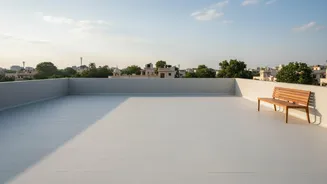
A cool roof isn't just about painting your terrace white. While any light colour is better than a dark one, a true cool-roof coating is a high-tech solution designed specifically to combat solar heat. These are advanced, elastomeric paints containing special pigments, often including ceramics or titanium dioxide. Their purpose is twofold: to have a high solar reflectance (to bounce sunlight back) and a high thermal emittance (to radiate away any heat that is absorbed). A normal white paint might reflect visible light, but these specialized coatings are engineered to reflect the invisible infrared and ultraviolet rays that are primarily responsible for heat generation.
The Science of Staying Cool
The principle behind cool-roof coatings is simple and can be compared to choosing your clothes on a sunny day. A dark-coloured shirt absorbs sunlight and makes you feel hotter, while a white shirt reflects it, keeping you cooler. Cool-roof coatings do the same for your building on a much more effective scale. The key metric is the Solar Reflectance Index (SRI), a measure of a surface's ability to stay cool in the sun. The higher the SRI value, the better the roof is at reflecting solar radiation and staying cool. By reflecting a vast majority of the sun's rays, the coating prevents the roof slab from heating up in the first place, drastically reducing the amount of heat transferred into the rooms below.
The Four-Degree Claim: Fact or Fiction?
The headline's promise of a four-degree drop is not an exaggeration; in many cases, it's a conservative estimate. Studies and real-world projects across India have consistently demonstrated significant temperature reductions. A study by the Natural Resources Defense Council (NRDC) found that cool roofs can lower indoor temperatures by 2–5°C. Research in hot, dry climates has shown indoor temperature reductions of around 3.7°C. Some Indian manufacturers and case studies even report indoor temperature drops of up to 5°C. The actual reduction can vary depending on factors like the building's insulation, roof material, and the quality of the coating used, but a noticeable improvement in indoor comfort is a well-documented outcome.
Beyond a Cooler Room
The benefits of applying a cool-roof coating extend far beyond just feeling more comfortable. The most immediate impact for many is on their wallet. By reducing the indoor temperature, the load on air conditioners is significantly decreased, leading to energy savings that can range from 15% to 30%. This reduced energy consumption also means a smaller carbon footprint. Furthermore, these coatings protect the roof itself. By reflecting harsh UV radiation and reducing the extreme temperature fluctuations that cause concrete to expand and contract, a good quality cool-roof coating can prevent cracks and increase the lifespan of your roof, often providing an additional layer of waterproofing.
Making the Switch in India
The market for cool-roof coatings in India is growing, with many brands available. When choosing a product, look for its SRI value; a higher number is better. While it can be a DIY project, professional application is often recommended to ensure proper surface preparation—a clean, dry surface is crucial for the coating to adhere properly and last. Costs can vary based on the brand and the labour involved, but many homeowners find that the investment pays for itself within a few years through savings on electricity bills. Initiatives in cities like Hyderabad and Ahmedabad have already showcased the large-scale effectiveness of this technology in providing affordable relief from heat.