





Why Physicists Look Beyond Four Dimensions
The idea of extra dimensions dates back to the 1920s but has gained new life with modern theories like string theory. String theory, which requires extra dimensions for its mathematical consistency, proposes that our universe is like a 'brane'—a four-dimensional
surface existing within a higher-dimensional space. A primary motivation for these ideas is tackling the “hierarchy problem”: the baffling observation that gravity is vastly weaker than the other fundamental forces, like electromagnetism. One theory suggests that while the particles and forces of our daily lives are stuck on this brane, gravity is not. It gets to 'leak' or spread out into the extra dimensions, which would dilute its strength and explain why it feels so weak to us.
The Hunt for Evidence at the LHC
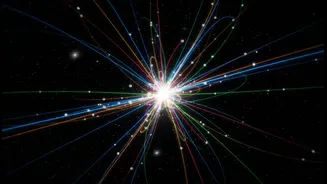
Theories are only as good as their testable predictions, and the search for extra dimensions has moved from blackboards to giant experiments like the Large Hadron Collider (LHC) at CERN. One way to find evidence is to look for signs of energy seemingly vanishing from a particle collision. If a graviton—the hypothetical particle that carries the force of gravity—is produced, it might escape into the extra dimensions. Detectors would register this as an imbalance, with less energy coming out of the collision than went in. Another method is to hunt for 'Kaluza-Klein' particles. These are predicted to be heavier versions of known particles, created by vibrations in the extra dimensions. Finding a W or Z boson that's a hundred times heavier than normal, for example, could be a tell-tale sign of these hidden geometries.
Cosmic Clues and Gravitational Waves
Particle colliders aren't the only place to look. The cosmos itself may hold clues. Some theories predict that extra dimensions could leave a faint, specific signature on gravitational waves—the ripples in spacetime created by massive events like merging black holes. As these waves travel across the universe, their interaction with extra dimensions could subtly alter them in ways our increasingly sensitive detectors might pick up. For instance, gravity 'leaking' into other dimensions would affect the measured distance to a cosmic event, creating a discrepancy between what gravitational wave detectors see and what traditional telescopes observe. So far, observations have not found definitive evidence, but as technology improves, listening to the universe's gravitational symphony could become a key test for these mind-bending theories.
Testing Gravity on a Tabletop
Perhaps the most direct test is also the smallest in scale. If extra dimensions exist and are 'large' (on a sub-millimeter scale), they should change how gravity behaves at very short distances. In our normal experience, gravity follows a precise inverse-square law. But if there are extra dimensions for gravity to spread into, it should become stronger than predicted when you get extremely close to an object. Scientists have designed incredibly sensitive tabletop experiments using tools like torsion pendulums and micro-cantilevers to measure the force of gravity at micron-level distances. So far, these experiments have confirmed Newton's law down to tens of micrometers, ruling out some of the simplest models of large extra dimensions. While no deviations have been found yet, these experiments continue to push the boundaries, tightening the constraints on what these hidden dimensions could look like.