






A Landmark Achievement
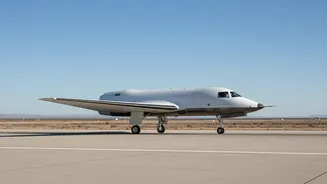
ISRO has successfully conducted the latest Landing Experiment (LEX) for its Reusable Launch Vehicle (RLV) program. In a precisely controlled test, the winged vehicle, named 'Pushpak', was carried to an altitude of 4.5 kilometres by an Indian Air Force
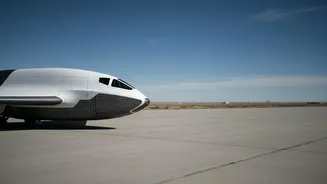
Chinook helicopter and released. From there, it navigated its own flight path, corrected for wind and other variables, and executed a perfect autonomous landing on a runway at the Aeronautical Test Range in Chitradurga, Karnataka. This wasn't just about landing; it was about proving the vehicle could handle challenging conditions and land with pinpoint accuracy, simulating the difficult return from a space mission.
The Reusable Rocket Revolution
For decades, space launches have operated on a simple but incredibly expensive principle: use it once and throw it away. Rockets, which are marvels of engineering, are almost entirely expendable. The most expensive components, including the powerful engines and sophisticated electronics, burn up in the atmosphere or fall into the ocean after a single mission. This is like building a brand-new airplane for every single flight. A Reusable Launch Vehicle, or RLV, changes this paradigm completely. The goal is to create a vehicle whose most valuable parts can return to Earth intact, be refurbished, and fly again, drastically cutting the cost of each subsequent launch.
Meet Pushpak: India's Space Shuttle
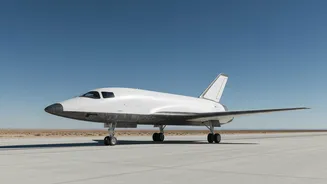
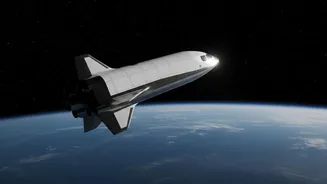
ISRO's RLV Technology Demonstrator, nicknamed 'Pushpak' after the mythological flying palace from the Ramayana, is at the heart of this ambition. It's a winged vehicle that looks like a miniature space shuttle. The recent series of landing tests are a crucial step-by-step validation of the technologies needed for this vision. Unlike some other global players that focus on vertically landing rocket boosters, ISRO's approach involves a winged body that lands horizontally on a runway, much like a conventional aircraft. The autonomous landing is particularly critical. The vehicle glides in without power at very high speeds—over 320 kmph, faster than a commercial jetliner—and must manage its own descent and touchdown using its onboard computers, navigation systems like NavIC, and control surfaces.
The Billion-Dollar Question: How Much Cheaper?
The primary driver for developing RLV technology is economics. Launching a satellite into space is a costly affair, with estimates sometimes running into tens of thousands of dollars per kilogram of payload. According to ISRO's own estimates, a successful RLV could slash these costs by as much as 80 percent. Such a massive cost reduction would not only make India's own space missions more sustainable but also position the country as a highly competitive player in the multi-billion dollar global satellite launch market. Cheaper launches would democratize access to space, enabling more scientific research, communication satellite deployments, and Earth observation missions.
India's Place in the New Space Race
While companies like SpaceX have already mastered and commercialized reusable rocket technology with their Falcon 9 boosters, ISRO's program is a strategic investment in developing its own indigenous capabilities. The focus is on creating a robust, cost-effective solution tailored to India's needs. The recent tests, which reused the same winged body from a previous mission, demonstrate the robustness and reliability of the hardware. This methodical, step-by-step approach—from hypersonic flight tests in 2016 to the recent series of successful autonomous landings—is a hallmark of ISRO's strategy, building confidence and mastering complex technologies one phase at a time.
What Comes Next on This Journey?
The successful completion of the landing experiments is a major milestone, but the journey is far from over. These tests simulated the final phase of a return from space. The next major challenge will be the Orbital Re-entry Experiment (ORE), where a scaled-up version of Pushpak will be launched into orbit and must survive the fiery re-entry through Earth's atmosphere before performing its autonomous landing. This will test the vehicle's heat shields and its ability to handle extreme aerodynamic stresses. The ultimate goal is to develop a two-stage-to-orbit (TSTO) launch vehicle where the second stage, carrying the satellite, would fly back to Earth, ready for its next mission.