

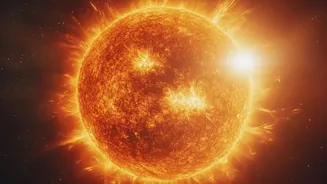
Our Star’s Turbulent Temperament
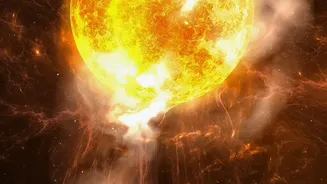
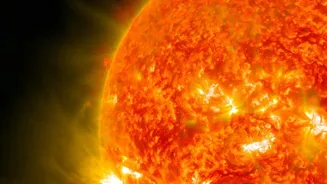
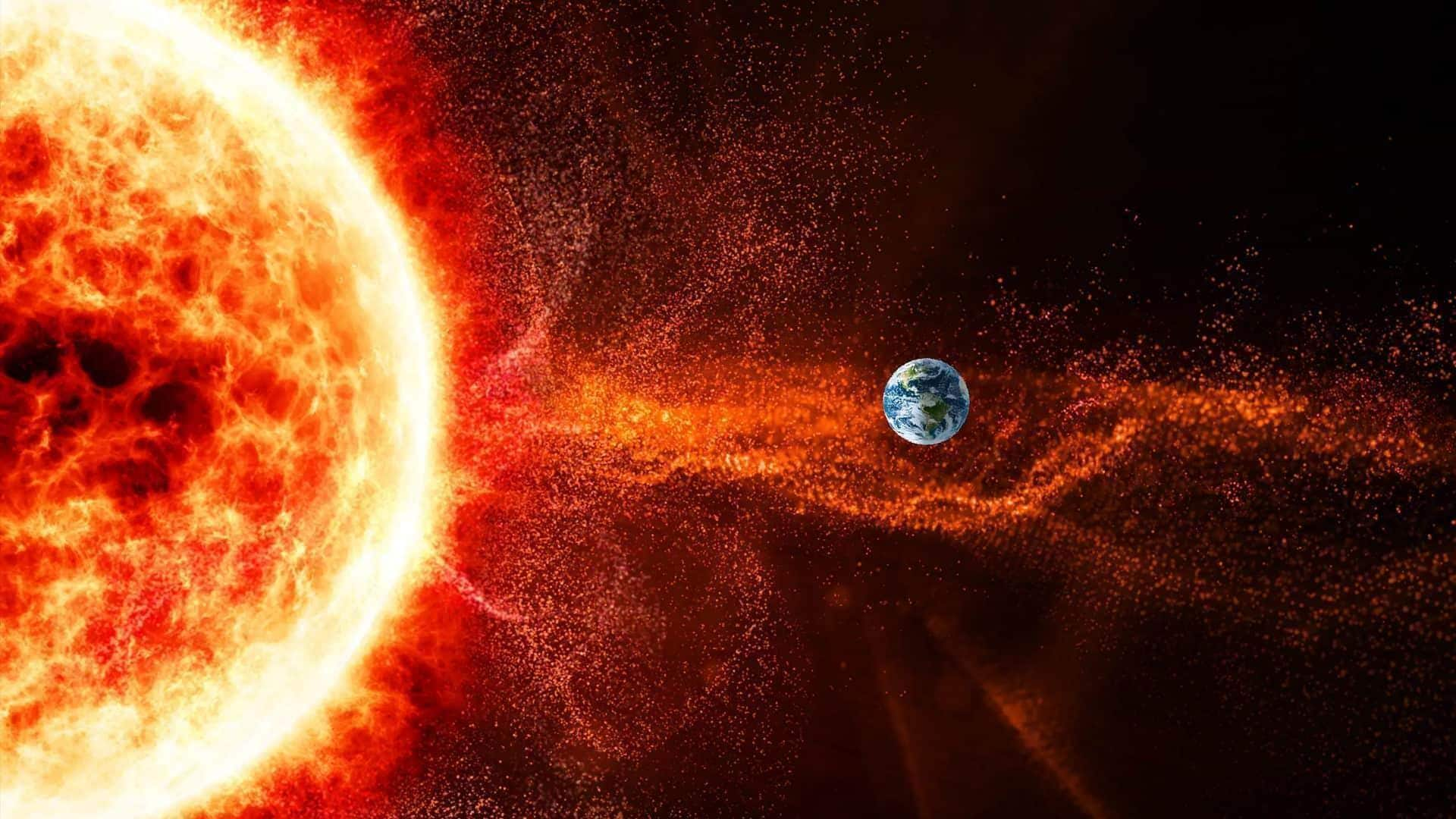
The Sun, while essential for life, has a volatile side. It periodically unleashes solar storms, which are massive eruptions of energy and particles. The most powerful of these, called Coronal Mass Ejections (CMEs), hurl billions of tons of solar plasma
into space. If aimed at Earth, these storms can wreak havoc on our technology-dependent society. They can disrupt communication networks, damage satellites, overload power grids, and pose a risk to astronauts. Predicting when these storms will occur and how they will behave is crucial for mitigating their impact. The key to this prediction lies in understanding the Sun's outermost atmosphere: the corona.
The Advantage of an Unblinking Eye
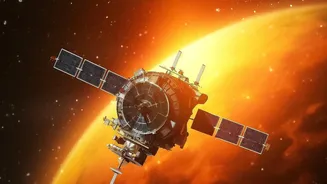
Studying the corona from Earth is difficult because the Sun's own brilliant light obscures it. This is why ISRO strategically placed Aditya-L1 at Lagrange Point 1 (L1), about 1.5 million kilometers from Earth. At this unique location, the gravitational pulls of the Sun and Earth balance out, allowing the spacecraft to maintain a stable position. More importantly, it provides a continuous, uninterrupted view of the Sun, free from the day-night cycle and atmospheric distortion of Earth-based observations. This constant watch is fundamental for catching the very first signs of a developing solar storm.
Seeing the Unseen with VELC
The star instrument aboard Aditya-L1 for this task is the Visible Emission Line Coronagraph (VELC). A coronagraph is a special telescope that blocks the bright solar disk, creating an artificial eclipse to make the faint corona visible. VELC is designed to observe the very initiation of CMEs closer to the Sun's surface than ever before. It doesn't just take pictures; it performs spectroscopy, breaking down the corona's light to measure its temperature, velocity, and density. By analyzing this data, scientists can understand how the plasma and magnetic fields are behaving just before and during an eruption.
From Raw Data to Actionable Forecasts
The observations from VELC and other instruments are a game-changer for prediction models. Previously, we could often only see a CME after it had already left the Sun. Aditya-L1 captures the build-up phase. For instance, recent observations of a CME revealed crucial details about changes in temperature, a dimming of the corona as material was ejected, and how the Sun's magnetic field can deflect the eruption's path. Understanding this deflection is vital, as it determines whether a CME will hit Earth. This high-resolution data on the origin and early dynamics of CMEs allows scientists to create more accurate and timely space weather forecasts, blending physics-based models with artificial intelligence.
Protecting Our Modern World
Better predictions translate directly into better protection. An early warning of an impending solar storm, thanks to Aditya-L1's data, gives satellite operators time to put their spacecraft into a safe mode, power grid managers a chance to protect their systems from surges, and airlines the ability to reroute flights to avoid communication blackouts and radiation exposure. As India's reliance on space-based technology for everything from digital payments to disaster management grows, this self-reliance in space weather forecasting becomes a critical national asset. Aditya-L1 is not just advancing solar science; it is building a shield for our digital infrastructure.