



The Universe’s Ultimate Speed Limit
Everything you see is because of light. But light, while incredibly fast, doesn't travel instantaneously. It moves at a blistering 299,792 kilometres per second. That’s fast enough to circle the Earth more than seven times in a single second. On a human
scale, this speed seems infinite. When you flip a switch, the room is lit instantly. But when we look at the cosmos, the distances are so mind-bogglingly vast that even light takes time—a lot of time—to cross them. This is where the concept of a 'light-year' comes in. It’s not a measure of time, but the distance light travels in one year: about 9.46 trillion kilometres. So, when we say a star is 10 light-years away, we mean the light we are seeing from it tonight actually left that star 10 years ago.
Our Closest Neighbours, A Decade Ago
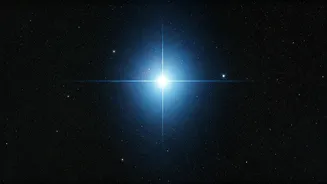
Think of the brightest star in our night sky, Sirius, known in India as Vyadha. It's a brilliant beacon, especially in the winter months. Sirius is relatively close to us in cosmic terms, sitting just 8.6 light-years away. This means the twinkling light reaching your eyes tonight left Sirius back in 2015 or 2016. It has been travelling across space during some of the most recent significant events in our own lives. The light from our closest stellar neighbour, Proxima Centauri (part of the Alpha Centauri system), is 4.2 light-years old. It's a constant, humbling reminder that even the nearest things in the cosmic neighbourhood are separated by an immense gulf of space and time.
Peering into Human History
This is where it gets truly fascinating. As we look at stars farther away, we are looking deeper into the past. Take Polaris, the North Star, known as Dhruva Tara. It's a crucial star for navigation, a seemingly fixed point in the heavens. But its light isn't from today or last year. Polaris is approximately 433 light-years away. The light we see from Dhruva Tara tonight left its surface around the year 1591. In India, that was during the height of the Mughal Empire, under the reign of Emperor Akbar. While architects were building the great monuments of Fatehpur Sikri, the photons of light you are capturing with your eyes tonight were just beginning their epic journey across the void. The night sky is not a snapshot of the present; it's a collage of different historical eras, all displayed at once.
Constellations: An Illusion of Time and Space
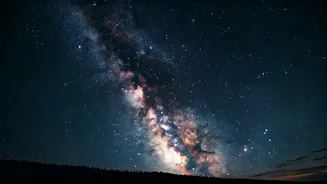
We love to connect the dots and form patterns, like the great hunter Orion (Mrigashirsha) or the seven sages of Saptarishi (the Big Dipper). But these constellations are an illusion of perspective. The stars that form them are often not related and are at vastly different distances from us. In Orion, the reddish star Betelgeuse is about 640 light-years away; its light comes to us from the 14th century. But the brilliant blue-white star Rigel, in the same constellation, is much farther, at around 860 light-years. Its light began its journey in the 12th century, during the time of the Chola dynasty in South India. The 3D reality is that these stars are nowhere near each other. They just happen to line up perfectly from our vantage point on Earth, creating a beautiful, time-distorted picture.
Beyond Our Galaxy: A Million-Year Gaze
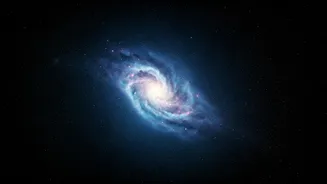
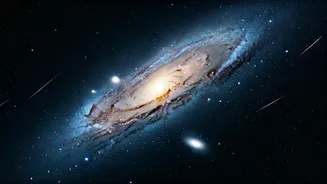
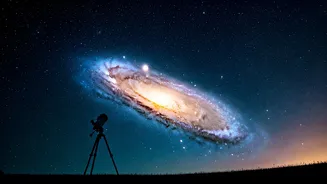
The ultimate act of cosmic time travel possible with the naked eye is to spot the Andromeda Galaxy. On a very dark, clear night, away from city lights, it appears as a faint, fuzzy smudge in the sky. That smudge is our nearest major galactic neighbour, a spiral galaxy like our own Milky Way, but containing a trillion stars. It is 2.5 million light-years away. This is not a typo. The faint light from Andromeda that you might glimpse tonight left that galaxy 2.5 million years ago. At that time, modern humans did not exist. Our distant ancestors, early hominids of the genus Australopithecus, were roaming the plains of Africa. The light from Andromeda has been travelling towards us throughout the entire span of human evolution. You are, quite literally, looking at a prehistoric sky.