


The Mission to Take India to Space
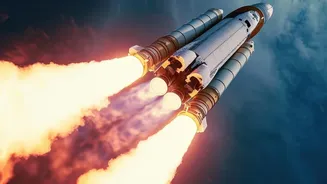
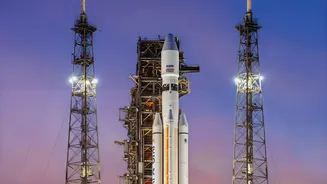
The Gaganyaan programme is India’s ambitious endeavour to demonstrate human spaceflight capability by launching a crew of three members into an orbit of 400 kilometres for a three-day mission. After bringing them back safely to Earth by landing in Indian
sea waters, India will join the elite club of nations—the US, Russia, and China—capable of conducting independent human spaceflights. The mission is not just a matter of national prestige; it is a complex undertaking that involves developing and mastering a host of critical technologies, from a human-rated launch vehicle (HLVM3) to advanced life support systems. At the heart of this human-centric mission lies one paramount principle: astronaut safety.
The Ultimate Safety Net
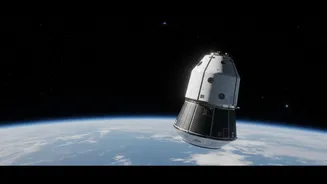
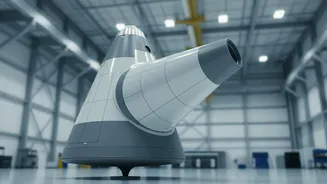
Before astronauts, or 'vyomanauts', can strap into the crew module, ISRO must be able to guarantee their safety in any conceivable emergency. The most dangerous phase of any space mission is the launch. This is where the Crew Escape System (CES) comes in. The CES is a rapid-response safety mechanism designed to pull the crew module and its occupants away from the launch vehicle in a fraction of a second if a catastrophic failure is detected on the launchpad or during ascent. It functions like a highly sophisticated ejection seat, but instead of ejecting a single pilot, it yanks the entire capsule to a safe distance using powerful, quick-acting solid motors. The goal is to ensure the crew can survive an emergency and be recovered safely, no matter what happens to the rocket below.
Simulating a High-Stakes Emergency
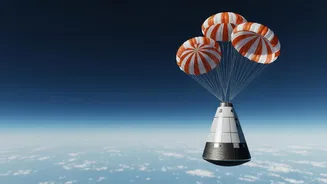
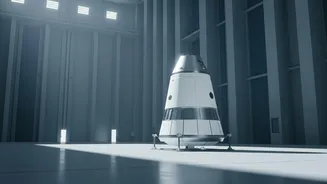
The latest series of tests focused on validating this very system under high-altitude conditions. While earlier tests, like the Pad Abort Test in 2018, demonstrated an escape from the launchpad, this new phase simulates an emergency occurring higher up in the atmosphere. These tests are designed to prove the system can function flawlessly in the thinner air and higher velocities of an ascending rocket. The Test Vehicle Abort Mission-1 (TV-D1) was a key flight in this series, designed to validate the performance of the entire escape system. During these tests, a simulated crew module is launched to a specific altitude to trigger the abort sequence. Hundreds of sensors record every parameter, from the performance of the abort motors to the deployment of the parachutes that bring the capsule safely back to Earth. Successfully demonstrating this capability is non-negotiable before the first uncrewed, and eventually crewed, flights can proceed.
The Road to the Stars
With the successful validation of the Crew Escape System, ISRO has cleared a major psychological and technical hurdle. This success builds on a series of other critical tests, including those for the drogue parachutes that stabilize and slow the module during re-entry and the flotation systems that keep it upright after splashdown in the ocean. Each successful test brings the Gaganyaan mission closer to its next major milestones. The roadmap includes further integrated air drop tests and at least two uncrewed orbital flights to validate all systems in real-world conditions. One of these uncrewed missions will even feature 'Vyommitra', a half-humanoid robot, to test the cabin environment before any human flies. These missions will test everything from the life support systems to the re-entry and recovery procedures, paving the way for the historic first crewed flight.