





A Front-Row Seat to the Sun
At the heart of the Aditya-L1 mission is its unique destination: a halo orbit around the Lagrange Point 1 (L1), approximately 1.5 million kilometres from Earth. This strategic location is a gravitational sweet spot where the pull of the Sun and Earth balance
out, allowing the spacecraft to 'hover' with minimal fuel. The key advantage of this is an uninterrupted, 24/7 view of the Sun, free from the eclipses or atmospheric distortions that hinder Earth-based observations. This constant vigilance is crucial for tracking solar phenomena in real-time, providing an early warning system for space weather events that could impact our planet.
Seven Eyes on Our Star
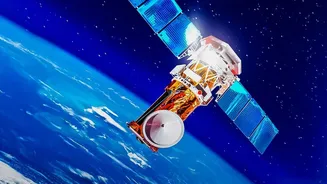
Aditya-L1 is equipped with seven state-of-the-art payloads, all developed indigenously in India. These instruments are designed to observe the Sun's various layers, from the photosphere and chromosphere to the mysterious, superheated corona. Four of these are remote-sensing payloads that will directly observe the Sun, while the other three are in-situ instruments that will study particles and magnetic fields in the local environment at L1. This dual approach of looking and 'touching' allows for a comprehensive study of solar dynamics, from the origin of violent solar flares and Coronal Mass Ejections (CMEs) to the composition of the solar wind that constantly flows past Earth.
Solving Solar Puzzles
The mission aims to tackle some of the most fundamental unsolved problems in solar physics. A primary objective is to understand the coronal heating problem: why the Sun's outer atmosphere, the corona, is millions of degrees hotter than its surface, which is a mere 6,000°C. By observing the corona in different wavelengths, payloads like the Visible Emission Line Coronagraph (VELC) and the Solar Ultraviolet Imaging Telescope (SUIT) will gather crucial data on the energy transfer mechanisms. Recent findings from the mission have already provided new insights, with scientists detecting small-scale solar brightening events that precede major flares, a step towards more reliable space weather forecasting.
A Unique Global Contributor
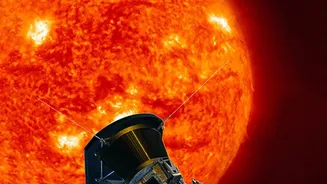
While other space agencies like NASA and the European Space Agency (ESA) have their own solar missions, such as the Parker Solar Probe and Solar Orbiter, Aditya-L1 carves out a unique and complementary role. NASA's Parker Solar Probe is designed to get extremely close to the Sun, flying through its corona. In contrast, Aditya-L1 is a dedicated observatory from a distance, providing a constant, wide-angle view that close-up missions cannot. This makes it an invaluable asset for global science, providing context and continuous monitoring that complements the high-risk, high-reward data from probes that 'touch' the Sun. The mission has already led to successful international collaborations, combining its data with that of European missions to get a more complete picture of solar events.
Securing India's Future in Space
Beyond pure science, Aditya-L1 has profound strategic implications. By providing improved forecasting for space weather, the mission helps safeguard India's critical infrastructure, including communication satellites, navigation systems like GPS/NavIC, and power grids, from destructive solar storms. This capability is vital for a modern, technology-driven economy. Furthermore, the successful execution of such a complex deep-space mission enhances ISRO's credentials, supporting future ambitious projects like the Gaganyaan human spaceflight program and the Bharatiya Antariksha Station. It firmly establishes India not just as a participant, but as a leader with indispensable capabilities in the global effort to understand our star.