



A Telescope Spanning Two Continents
First, let's clear up a common misconception. The SKA isn't one single, colossal dish. It’s a globe-spanning network of thousands of antennas, working together as one giant observatory. The project is so vast that it's split across two remote, radio-quiet
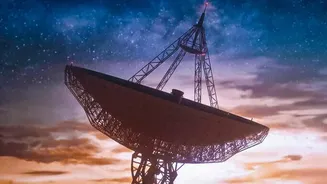
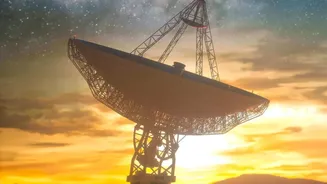
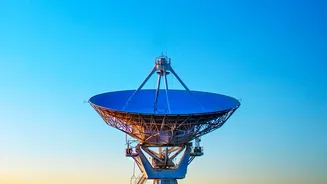
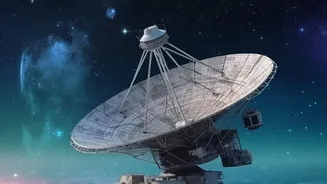
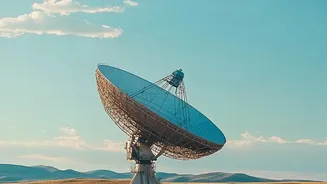
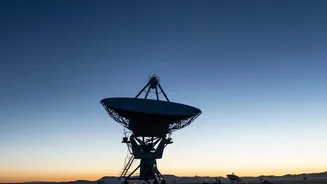
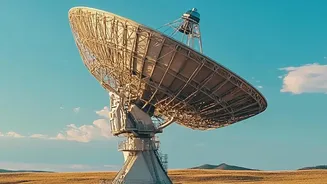
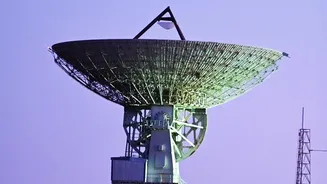
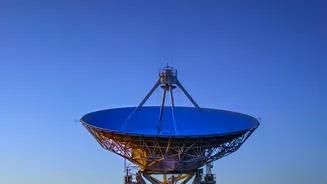
locations to avoid interference from our noisy electronic world. The SKA-Mid array, featuring hundreds of classic dish antennas, is located in South Africa's Karoo desert. Meanwhile, over 131,000 smaller, Christmas-tree-like dipole antennas, known as SKA-Low, are being installed across the desert of Western Australia. Together, they form a single, extraordinarily powerful instrument managed by an international consortium headquartered in the UK.
The Power of Working Together
So, how do thousands of smaller antennas become the world's most sensitive telescope? The magic lies in a technique called interferometry. Instead of relying on one massive collecting surface, astronomers combine the signals captured by each individual antenna. By precisely synchronising these signals using atomic clocks and supercomputers, they can create a 'virtual' telescope with a resolving power equivalent to a single dish as wide as the maximum distance between the antennas—stretching for tens or even hundreds of kilometres. This allows the SKA to see the sky in far sharper detail than any single telescope could ever achieve. The more antennas in the array, the more sensitive it becomes, enabling it to pick up the incredibly faint radio waves that have travelled for billions of years across the cosmos.
Tuning into the Cosmic Dawn
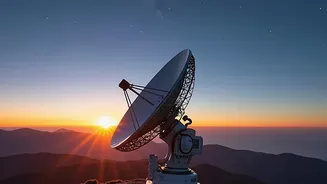
The 'ancient signals' the SKA is hunting for are no ordinary radio waves. A primary mission is to peer back in time to a period known as the Epoch of Reionization. This was a mysterious era, roughly a billion years after the Big Bang, when the very first stars and galaxies ignited, filling the dark, neutral universe with light for the first time. As the universe has expanded over 13 billion years, the light from this period has been stretched into long-wavelength radio waves. The SKA is designed specifically to detect these faint, 'redshifted' signals from primordial hydrogen gas. By mapping this ancient hydrogen, scientists hope to create a 3D picture of the early universe as it was first taking shape, effectively watching the cosmic dawn unfold.
India’s Critical Role in the Mission
India is not just a bystander in this global endeavour; it is a full-fledged member of the SKA Organisation, committing ₹1,250 crore to the project. Indian scientists and engineers, led by the National Centre for Radio Astrophysics (NCRA) in Pune, have been instrumental from the start. India's most significant contribution is the design and development of the telescope's incredibly complex 'neural network'—the Telescope Manager. This sophisticated software system will be the brain of the entire observatory, responsible for controlling, monitoring, and operating the thousands of antennas across both continents in perfect harmony. This leadership role in developing the core software highlights India’s growing prowess in high-performance computing and complex project management on a global stage.
More Than Just the Beginning
While uncovering the secrets of the early universe is a key goal, the SKA's capabilities are vast. Its unprecedented sensitivity will allow scientists to conduct the most precise tests of Einstein’s theory of general relativity by observing pulsars, the super-dense, spinning remnants of stars. It will map the magnetic fields that thread through galaxies, explore the cradles where new stars and planets are born, and even hunt for the complex organic molecules that are the building blocks of life. The SKA will generate more data than any science facility in history, requiring some of the world's fastest supercomputers to process the flood of information and ushering in a new era of 'Big Data' astronomy.