





The Science of Living Light
The magic behind glowing plants is a natural phenomenon called bioluminescence, the same process that allows fireflies to light up summer nights. Scientists are using two main approaches to create these 'living lamps'. The first involves genetic engineering,
where genes from luminous organisms like fungi are inserted into a plant's DNA. This allows the plant to produce its own light continuously as part of its metabolic cycle, using compounds it already makes. The second, a field known as 'plant nanobionics' pioneered by researchers at MIT, involves infusing plant leaves with specialised nanoparticles. One method uses particles that act like a 'light capacitor': they absorb energy from sunlight during the day and then release it gradually as a glow for several hours after dark.
A Green Revolution for City Streets
The potential benefits for Indian metros are enormous. Street lighting is a significant drain on municipal resources and the national grid, accounting for a substantial portion of a city's energy budget. India has over 35 million streetlights, and transitioning even a fraction of them to a self-powered, zero-electricity solution could lead to massive energy savings and a reduced carbon footprint. Beyond the economic and environmental advantages, bio-plant lighting offers a softer, more natural illumination that could reduce light pollution, which harms urban wildlife and disrupts human sleep cycles. It also creates a unique aesthetic, turning ordinary parks and avenues into enchanting, naturally lit spaces, potentially boosting tourism and public engagement with green areas.
From Lab Bench to Lamppost
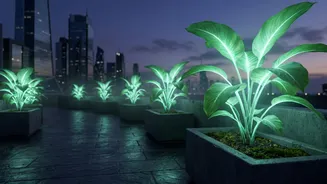
The vision is captivating: entire avenues lined with trees that glow brightly enough for pedestrians and vehicles, public squares illuminated by radiant shrubs, and homes lit by decorative glowing flowers. Early experiments have shown promise. Researchers in China created a wall of 56 luminescent succulents that produced enough light to read a book in the dark. Similarly, MIT engineers developed plants that, after just 10 seconds of charging from an LED, could glow for about an hour. This technology has been successfully applied to a range of common plants, including roses, petunias, and even large-leafed species like the Thailand elephant ear, suggesting its potential for use as an outdoor lighting source. A commercially available 'Firefly Petunia' in the US, created through genetic engineering, demonstrates that these innovations are already moving from the lab into everyday life.
The Hurdles on the Horizon
Despite rapid progress, we won't be replacing our LED streetlights with glowing trees just yet. The single biggest challenge is brightness. Currently, the light emitted by bioluminescent plants is relatively low, more suited for ambient or decorative purposes than for illuminating a busy thoroughfare. While much brighter than early prototypes, they do not yet compete with modern, high-efficiency LEDs that Indian cities are increasingly adopting. Other practical concerns include the lifespan and resilience of these plants in harsh urban environments, the cost of development and maintenance, and public and regulatory acceptance of genetically modified organisms in public spaces. For the nanoparticle approach, questions remain about long-term plant health and the scalability of infusing millions of plants needed for a city-wide grid.