


What Are 'Organic' Molecules?
First, let's clear up a common misconception. In the context of chemistry and space, 'organic' doesn't mean the food you find in a high-end grocery store. It simply refers to molecules that contain carbon atoms, typically bonded with hydrogen and other
elements like oxygen, nitrogen, and sulfur. Carbon is the ultimate socialite of the periodic table; its ability to form stable bonds with up to four other atoms allows it to create long, complex chains and rings that serve as the backbone for the essential molecules of life, including DNA, proteins, and sugars. So, when scientists get excited about finding organic molecules in space, they're not talking about finding extraterrestrial plants, but the fundamental chemical building blocks from which life, as we know it, could potentially arise.
A Cosmic Trail of Breadcrumbs
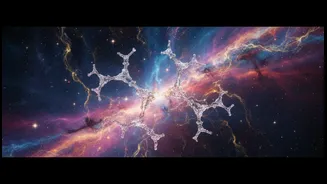
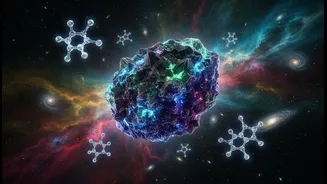
So where are we finding these cosmic ingredients? The answer, it turns out, is almost everywhere we look. For decades, scientists have studied meteorites that have crashed to Earth and found them brimming with organic diversity. Rocks from asteroids like Ryugu and Bennu, samples of which were recently returned to Earth by spacecraft, contain thousands of different organic compounds, including numerous amino acids—the very molecules life uses to build proteins. One sample from the asteroid Bennu even contained tryptophan, an amino acid not previously seen in extraterrestrial materials. Even more fascinating are the discoveries being made in the vast emptiness between stars. In cold, dark interstellar clouds, simple molecules can gather on dust grains, where they react to form more complex structures long before stars or planets are even born. Recent discoveries in a star-forming cloud called TMC-1 have identified dozens of prebiotic molecules, and even large, ring-shaped molecules like cyanocoronene, the largest of its kind ever detected in space.
The Power of New Telescopes
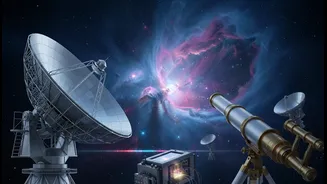
Much of this new knowledge is thanks to revolutionary tools like the James Webb Space Telescope (JWST). With its powerful infrared vision, JWST can peer through thick cosmic dust clouds that were previously impenetrable, revealing the chemical secrets within. In early 2026, astronomers using JWST announced an extraordinary discovery in a galaxy named IRAS 07251-0248. Deep in its dust-shrouded core, they found a surprisingly rich factory of organic molecules, including methane, benzene, and acetylene, in abundances far higher than models had predicted. This suggests that the harsh environments around supermassive black holes might actually serve as powerful engines for creating organic compounds. JWST has also detected complex organic molecules frozen in ice around a young protostar in a neighbouring galaxy, showing that these materials are present right at the start of a new solar system's life.
Closer to Home: Mars and a Tantalising Mystery
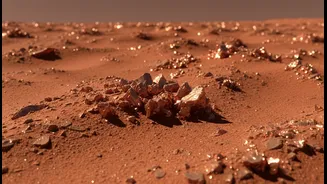
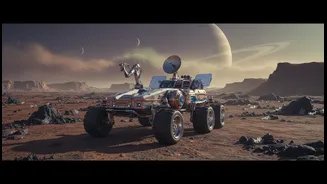
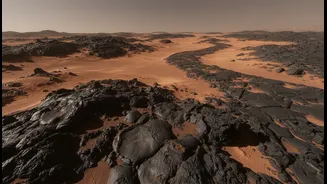
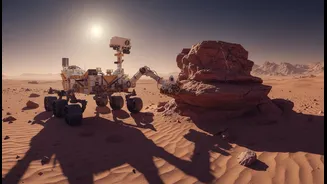
The search for organic chemistry isn't confined to distant galaxies. Right next door, on Mars, NASA's Curiosity rover has been making groundbreaking finds. It has confirmed the presence of a diverse collection of organic molecules in Martian rocks, including some never before seen on the Red Planet. While these molecules are not proof of life—they can be formed by geological processes—their presence confirms that ancient Mars had the right chemical ingredients to be habitable. Some discoveries are particularly tantalising. The rover found long-chain hydrocarbons which, on Earth, can be fragments of fatty acids created by biological processes. While scientists stress this is not definitive proof, a recent analysis concluded that a biological origin for these specific molecules is a reasonable hypothesis.
From Stardust to Us
The widespread presence of organic molecules across the cosmos has profound implications. It supports a hypothesis known as 'panspermia'—the idea that the building blocks for life didn't necessarily originate on Earth. Instead, they may have been delivered to our young planet by comets and asteroids billions of years ago. Finding amino acids, nucleobases (the building blocks of DNA and RNA), and other key compounds in these extraterrestrial objects shows that the raw materials for life are not exclusively terrestrial. The universe, it seems, is seeded with the potential for life. The chemistry that underpins our own existence appears to be a universal phenomenon, beginning in the dark voids between stars and culminating in planets, moons, and perhaps, life itself.