





The Sun’s Hidden Engine Room
Imagine a vast, invisible border deep within the Sun. Above this line, in the convection zone, hot plasma boils and churns like water in a pot, with the Sun's equator spinning faster than its poles. Below this line, in the radiative zone, energy moves
more calmly, and the entire zone rotates as a single, solid body. The thin, highly sheared layer where these two distinct regions meet is called the tachocline. First theorized in 1992, this layer is only about 30,000 kilometres thick—a sliver compared to the Sun's 700,000-kilometre radius—but the immense physical forces at play make it one of the most dynamic places in the solar system. This is where the smooth, rigid rotation of the solar interior clashes with the chaotic, differential rotation of the outer layers, creating an environment of incredible stress and shear.
Forging the Sun's Magnetic Field
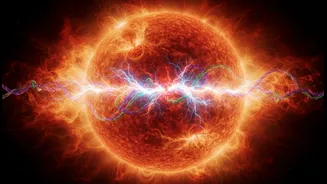
Scientists believe this intense shearing is the primary engine for the Sun's magnetic field, a process known as the solar dynamo. The differential rotation within the tachocline is thought to take weak, looping magnetic fields and stretch, twist, and amplify them into powerful, rope-like structures. This process, often called the omega-effect, creates the immensely strong toroidal fields that are the foundation of solar activity. While some theories suggest the dynamo could operate closer to the surface, recent evidence from helioseismology—the study of the Sun's interior using wave oscillations—points to the tachocline as the deep-seated origin. The magnetic fields generated here don't stay put; they eventually become buoyant, rising through the convection zone to emerge at the surface as sunspots, the precursors to major solar events.
From Deep Shear to Violent Eruptions
The link between the tachocline and the solar flares or Coronal Mass Ejections (CMEs) that threaten Earth is direct. The magnetic energy built up and stored in the tachocline eventually breaks through the surface, creating complex and unstable active regions. When these tangled magnetic field lines suddenly realign, they release a tremendous amount of energy in the form of a solar flare or a CME—a massive explosion of plasma and magnetic field into space. The strength and frequency of these eruptions are governed by the 11-year solar cycle, which itself is driven by the dynamo processes in the tachocline. By studying the shear patterns deep inside the Sun, scientists hope to one day predict the strength of an upcoming solar cycle and the likely intensity of its storms, moving from observation to genuine forecasting.
Protecting Our High-Tech World
For our technology-dependent society, the stakes are enormous. A powerful CME directed at Earth can have catastrophic consequences. The influx of charged particles can disrupt the planet’s magnetic field, creating a geomagnetic storm. These storms can fry satellite electronics, disrupting GPS, global communications, and financial transactions. They can also induce powerful currents in ground-based electrical grids, potentially damaging transformers and causing widespread, long-lasting blackouts, as happened in Quebec in 1989. An accurate forecast, even with just a few hours of lead time, would allow grid operators to take preventative measures, satellite operators to put spacecraft into safe mode, and airlines to reroute flights away from polar regions where radiation exposure is highest. Understanding the tachocline isn't just about understanding the Sun; it's about building resilience against its most powerful outbursts.