


A World of Fire and Shadow
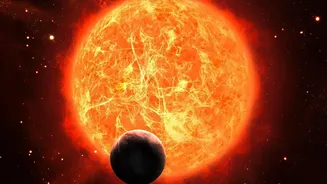
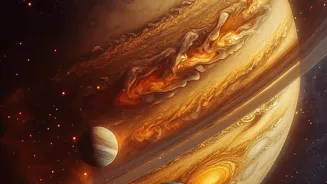
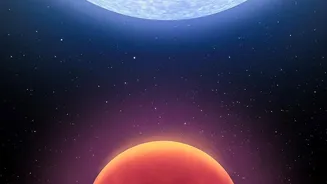
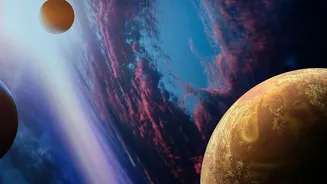
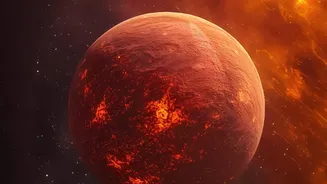
The subject of this extraordinary weather report is an exoplanet named WASP-76b, located about 640 light-years away. This behemoth is a type of planet known as an “ultra-hot Jupiter,” a gas giant that orbits perilously close to its star. This proximity
has a profound effect: the planet is tidally locked, meaning one side perpetually faces the star's blistering heat while the other is cloaked in eternal night. The day side of WASP-76b is so intensely irradiated that temperatures soar above 2,400 degrees Celsius, hot enough to vaporize metals like iron. The night side, while still incredibly hot by Earthly standards at around 1,500 degrees Celsius, is cool enough for those metals to condense.
How Metal Becomes Rain
The concept of iron rain sounds like science fiction, but it is the result of extreme physics. On the scorching day side of WASP-76b, the intense heat turns iron into a gas, which then rises into the atmosphere. This iron vapor doesn't stay put. The huge temperature difference between the day and night sides generates ferocious, high-speed winds that whip the iron vapor over to the planet's cooler, dark hemisphere. As the vapor reaches the night side, it cools, condenses back into a liquid, and falls as droplets of molten iron. Essentially, the planet has a water cycle, but with a substance that we use to build skyscrapers. These droplets then fall deeper into the gas giant's atmosphere, where they are eventually vaporized again, continuing the cycle.
Painting a Portrait with Light
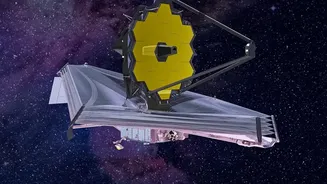
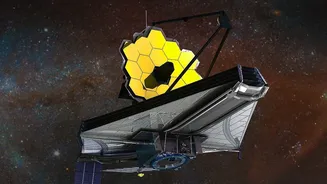
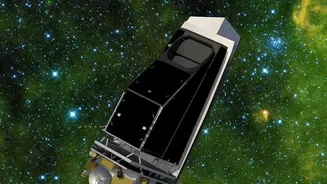
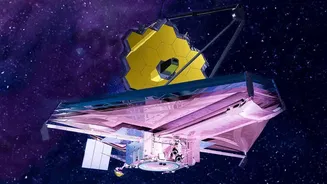
Scientists can't see this iron rain directly, but they can infer its presence by using a technique called spectroscopy. Telescopes like the European Southern Observatory's Very Large Telescope (VLT) and the James Webb Space Telescope (JWST) can analyze the light that passes through or is emitted by an exoplanet's atmosphere. As WASP-76b orbits its star, astronomers measure how the light changes. They detected a strong chemical signature of iron vapor at the “evening” boundary, where the day side rotates out of view. Crucially, that signature was absent at the “morning” boundary, as the night side rotated back into view. This disappearing act strongly implies that the iron vapor condensed and rained out on the night side before it could complete its journey back to the day side. This technique, called phase curve analysis, allows scientists to create a basic map of the planet's temperature and chemical composition across its different longitudes.
Blueprints for Alien Climates
While the initial discovery of iron rain on WASP-76b was a landmark moment, subsequent research has added more nuance. Some studies have suggested the signal might also be explained by extreme temperature variations rather than condensing iron alone, highlighting the complexity of studying these remote worlds. Regardless, these observations represent a monumental leap in our capabilities. We have moved from simply detecting exoplanets to actively characterizing their atmospheres and mapping their weather systems. Instruments like the ESPRESSO spectrograph on the VLT and the powerful infrared eyes of the JWST are giving us the tools to understand the large-scale wind patterns and chemical processes that govern these alien climates. By creating these weather maps, scientists can test and refine their models of how atmospheres behave under extreme conditions, providing insights that are impossible to gain from studying our own solar system alone.