





The 'Gourmet' Illusion
Walk down any pet food aisle in India, and you're met with a dazzling array of options. Bags with pictures of pristine salmon fillets and dew-kissed carrots promise a 'gourmet' experience for our dogs and cats. The word itself conjures images of high-quality,
exotic ingredients and skilled preparation. But here’s the hard truth: in the world of pet food, 'gourmet' is little more than a marketing buzzword. Unlike terms that are regulated, 'gourmet', 'premium', or 'holistic' have no official definition. They are designed to appeal to our human emotions and our desire to pamper our pets. A manufacturer can use these words on a bag of highly processed kibble with minimal high-quality ingredients, and it would be perfectly legal. This creates a dangerous illusion, leading well-intentioned pet parents to believe they are buying a superior product when they might just be paying for clever advertising.
What Your Pet Actually Needs
If 'gourmet' is meaningless, what should we be looking for? The answer lies in nutritional science. Dogs and cats have specific dietary requirements that are very different from our own. Cats, for instance, are obligate carnivores, meaning they absolutely must have nutrients found in animal tissue to survive. They have a higher need for protein and specific amino acids like taurine and arginine than dogs do. Dogs are generally considered omnivores and can derive nutrients from a wider variety of sources, but their diet must still be built around a strong foundation of high-quality protein. Global bodies like the Association of American Feed Control Officials (AAFCO) and, in India, the Bureau of Indian Standards (BIS), provide guidelines for what constitutes a 'complete and balanced' diet for different life stages, like puppies, adults, and seniors. These standards are the real benchmark of quality, not the flowery language on the front of the bag.
Reading a Label Like a Pro
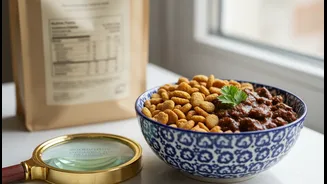
Learning to decode a pet food label is the single most powerful tool you have. In India, like in most places, ingredients must be listed in descending order by weight. This means the first few ingredients make up the bulk of the food. Here's your filter: look for a named animal protein source—like 'chicken', 'lamb', or 'fish'—as the first ingredient. Vague terms like 'meat and animal derivatives' are a red flag; they can be sourced from lower-quality parts and the origin is unclear. The next section to check is the 'Guaranteed Analysis', which lists the minimum percentages of crude protein and fat, and the maximum percentages of fibre and moisture. This helps you compare products on a like-for-like basis. A food that meets AAFCO or BIS nutritional adequacy standards for your pet’s life stage is a must.
Beyond Buzzwords: 'Human-Grade' and 'Natural'
Other terms like 'human-grade' and 'natural' also require a critical eye. 'Human-grade' has a legal definition, meaning every ingredient is handled in a way that is compliant with regulations for human food. This suggests a higher standard of safety and ingredient quality. However, a 'feed-grade' product can still be nutritious, and a 'human-grade' one is not automatically nutritionally superior without being properly balanced. Similarly, 'natural' is a vague term that can be used loosely. The real story isn't in these single words but in the complete picture: a clear ingredient list, a solid guaranteed analysis, and adherence to established nutritional profiles. Don't let one appealing word distract you from evaluating the entire label.
Applying the Pet-Health Filter
So, how do we apply this pet-health filter? It starts with a shift in mindset. Instead of being swayed by beautiful packaging or promises of a 'gourmet' feast, we must become discerning consumers on our pet's behalf. Ask critical questions. What is the primary protein source? Is the food formulated for my pet’s specific life stage (puppy/kitten, adult, senior)? Does it meet established nutritional standards? Is the brand transparent about its sourcing and manufacturing processes? Choosing a pet food should feel less like ordering from a fancy menu and more like consulting with a nutritionist. Your goal isn’t to find the most exotic-sounding recipe, but the one that will deliver the most bioavailable, digestible, and appropriate nutrition to support your pet's long-term health and well-being.