





A Celestial Masterpiece
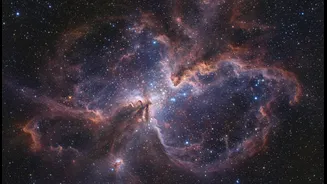
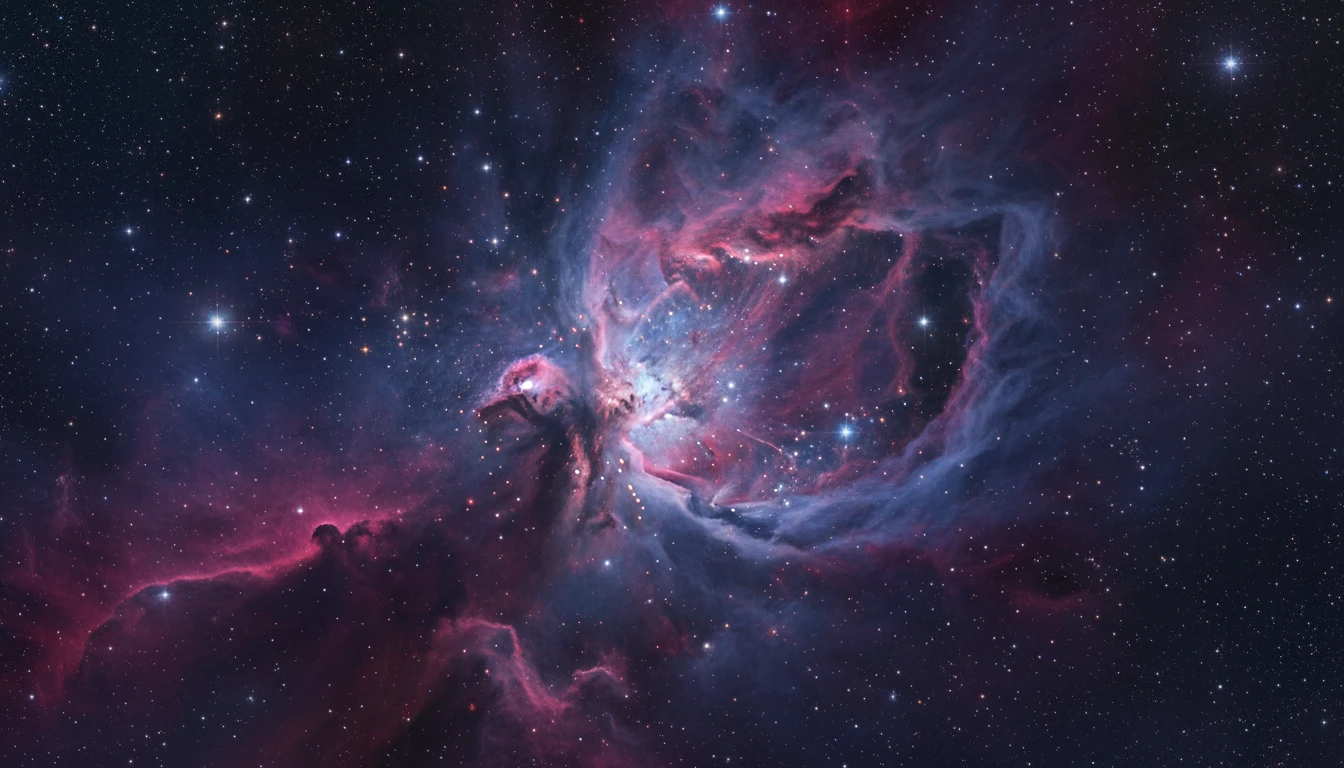
The latest celestial portrait from NASA's Hubble Space Telescope showcases LH 95, a sprawling stellar nursery located in the Large Magellanic Cloud, a dwarf galaxy that orbits our own Milky Way. The image is a spectacular display of colour and light,
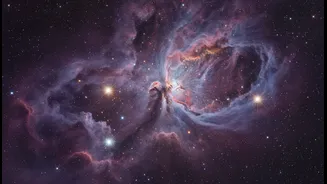
with brilliant blue and white stars set against a crimson backdrop of glowing hydrogen gas. Dark, thread-like filaments of cosmic dust stand out in sharp contrast, resisting the intense radiation from the newborn stars. This region is a stellar association, a place where thousands of young, low-mass stars coexist with massive blue giants, offering astronomers a valuable window into the processes that shape galaxies.
Inside the Star Factory
Stellar nurseries are vast, cold clouds of gas and dust that serve as the universe's maternity wards. These regions, sometimes called molecular clouds, are the birthplaces of all stars. Gravity is the master architect here, slowly pulling together dense clumps of hydrogen gas and dust over millions of years. As a clump collapses under its own weight, the core heats up, forming a protostar—a baby star that has not yet ignited. This dense, hot core continues to gather material from a rotating disk of gas and dust surrounding it. The entire process, from a collapsing cloud to a shining star, can take millions of years.
What This New View Reveals
The new Hubble image of LH 95 is more than just a pretty picture; it's a scientific treasure trove. The image's stunning colours are chosen to represent different wavelengths of light, with the crimson glow coming from hydrogen-alpha emissions—a key indicator of active star formation. This allows astronomers to pinpoint the youngest stars embedded within the gas. Researchers studying LH 95 have identified an extraordinary 2,500 'pre-main-sequence' stars. These are stars that have gathered most of their mass but have not yet become hot or dense enough in their cores to start nuclear fusion, the process that makes a star shine. By studying these developing stars, scientists can confirm theories about how stars accumulate matter, finding that the rate of accretion slows down as the star ages.
The Seeds of Future Worlds
Studying stellar nurseries like LH 95 is fundamental to understanding our own cosmic origins. These are the environments where not just stars, but also planets, are formed from the leftover material in the accretion disk. The rich stellar population in LH 95 provides a relatively close and clear view of this process, as it has less obscuring dust than similar regions within our own Milky Way. The powerful winds and radiation from the most massive stars in the nursery sculpt the surrounding gas and can even trigger new waves of star formation. Every star in our night sky, including our own Sun, was born in such a dynamic environment billions of years ago. By observing these cosmic cradles, we are essentially looking back in time, piecing together the story of how galaxies evolve and create the building blocks for planets and, potentially, life.