



What Is the Horizon Illusion?
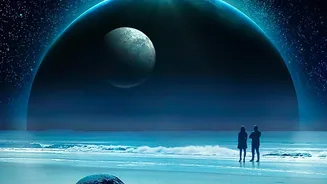
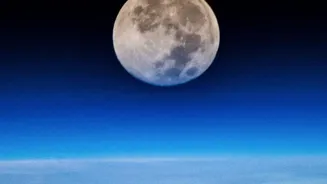
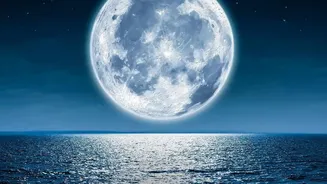
The 'horizon illusion' is most famously known as the Moon Illusion, but it also applies to the Sun and even constellations. It’s the powerful optical effect where the Moon appears significantly larger when it's close to the horizon compared to when it's high
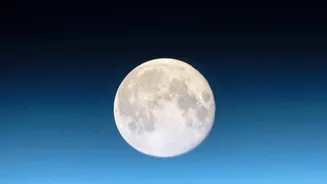
in the sky. Despite its dramatic appearance, the Moon's actual size in the sky doesn't change. You can prove this yourself by holding your finger out at arm's length; the Moon will be about the same width as your pinky fingernail, whether it’s rising or directly overhead. So if the Moon isn't physically getting bigger, what's going on? The answer isn't in the atmosphere, but inside our own minds.
A Trick of the Mind, Not the Sky
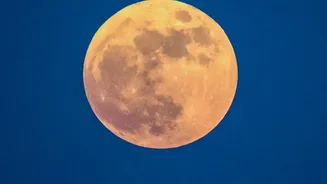
For centuries, people thought the atmosphere might be acting like a magnifying lens. While the atmosphere does cause the Moon to look more yellow or orange near the horizon and can slightly squash its shape, it doesn't magnify it. The leading explanation is a psychological one tied to how our brains perceive distance. One prominent theory involves the 'Ponzo Illusion'. This illusion demonstrates that when two identical objects are placed on converging lines (like railway tracks), our brain interprets the one that seems farther away as being physically larger. When the Moon is on the horizon, our brains use cues like trees, buildings, and hills to judge its distance. Since we perceive the horizon as being very far away, our brain concludes that for the Moon to appear that size at such a distance, it must be enormous. When the Moon is high in the empty sky, there are no reference points, so our brain perceives the sky overhead as closer, and the illusion vanishes.
The Photographer’s Secret Weapon
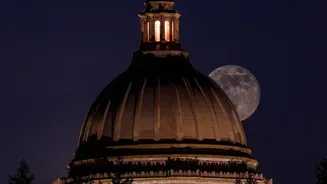
For photographers, the Moon Illusion is both a creative opportunity and a technical challenge. While the psychological illusion happens in our brain, photographers can use specific techniques to create photos that replicate and enhance this 'giant moon' effect. The key is using a long telephoto or zoom lens from a great distance away from a foreground subject, sometimes many miles. This technique, called lens compression, makes distant objects (like the Moon) and foreground objects (like a skyscraper) appear much closer together than they really are. It 'smooshes' the scene, making the Moon loom spectacularly behind landmarks. Capturing these shots requires meticulous planning using apps to align the Moon's position with a specific landmark at the right time, as well as managing camera settings like shutter speed and ISO to get a clear, sharp image without motion blur.
A Stargazer's Sense of Wonder
Stargazers are also well-acquainted with this celestial trickery. The same illusion that makes the Moon look huge also affects how we perceive constellations near the horizon. Star patterns like the Big Dipper can appear stretched out and unusually large when they are low in the sky, sometimes making them difficult to recognize at first glance. This happens because our brain applies the same flawed logic: objects near the horizon, which is perceived as distant, must be larger. For amateur and seasoned astronomers alike, this illusion adds to the wonder of the night sky. It's a reminder that observation is not just a physical act of seeing light, but an interpretive act performed by the brain. Constellations themselves are also a type of illusion—patterns formed by stars that are often hundreds of light-years apart and not related to each other at all.
Other Illusions of the Horizon
The Moon Illusion isn't the only trick the horizon plays on us. Other atmospheric phenomena can create equally baffling sights. Mirages, for instance, are not psychological illusions but real physical events caused by light bending as it passes through layers of air at different temperatures. A 'superior mirage' can make a distant ship or island appear to float in the air above the horizon. One of the most complex mirages is the Fata Morgana, a rare event where temperature inversions create distorted, stacked, and shimmering images of objects on the horizon, making them appear like fantastical castles in the sky. These phenomena, from the common highway mirage to the elusive Fata Morgana, highlight the fascinating interplay between light, our atmosphere, and the complexities of human perception.