







The Unheard Weapon
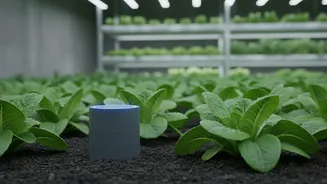
Imagine a silent force field protecting rows of kale and lettuce on a city rooftop. That’s the principle behind acoustic pest control, a rapidly advancing field of agricultural technology. Instead of spraying chemicals, this method uses low-frequency
sound waves and substrate-borne vibrations to create an environment that is inhospitable to many common agricultural pests. These sounds, often in the subsonic range below 20 hertz, are inaudible to humans but create significant disruption for insects that rely on subtle vibrations to communicate, find mates, and locate food. The technology can be deployed through specialized speakers that emit a low hum or via devices that attach directly to plant support systems, sending vibrations through the soil and plant stems.
How Sound Disrupts Pests
Many insects, like leafhoppers and certain stink bugs, live in a world of vibration. They 'talk' to each other by sending signals through plant leaves and stems. This is how they perform critical behaviors like courtship rituals and warning rivals. Low-frequency vibrations essentially act as a jamming signal, masking these vital communications. One study on grapevine pests showed that introducing disruptive vibrations, based on the signals rival males use to interrupt courtship, successfully prevented most mating. By creating constant, disruptive background 'noise,' the technology can confuse pests, stress them out, and interfere with their ability to reproduce, effectively driving them away from the crops without harming a single one.
A Game-Changer for Urban and Organic Farms
For organic urban farms, this technology is more than just a novelty; it’s a potential solution to one of their biggest operational hurdles. Confined urban spaces and proximity to people make traditional chemical pesticides completely impractical and undesirable. Acoustic methods offer a residue-free alternative that is safe for people, pets, and beneficial insects like pollinators. Companies are developing systems that can be precisely calibrated to target specific pests, leaving helpful bugs alone. This species-specific approach prevents the collateral damage associated with broad-spectrum sprays, preserving the delicate ecological balance that organic farms strive to maintain. By providing a clean, effective, and non-toxic pest management tool, sound-based systems can make urban agriculture more viable, scalable, and profitable.
From the Lab to the Rooftop Garden
While the science is strong, vibrational pest control is still an emerging technology. Much of the foundational research has been conducted in controlled settings like vineyards and labs, proving the concept's efficacy. The next step is translating this success to the varied environments of commercial urban farms. Companies are now developing and trialing smart systems that use AI and sensors to detect the specific pests present and deploy the correct disruptive frequencies in real time. Challenges remain, including the initial cost of the equipment and ensuring the vibrations are effectively transmitted across different soil types and container systems. However, as the technology becomes more affordable and adaptable, it promises to become a key tool in the modern farmer’s arsenal.