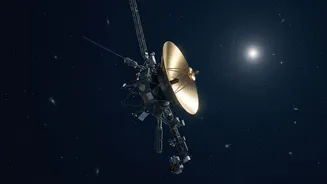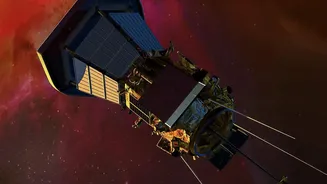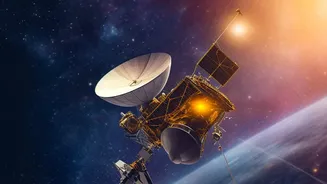

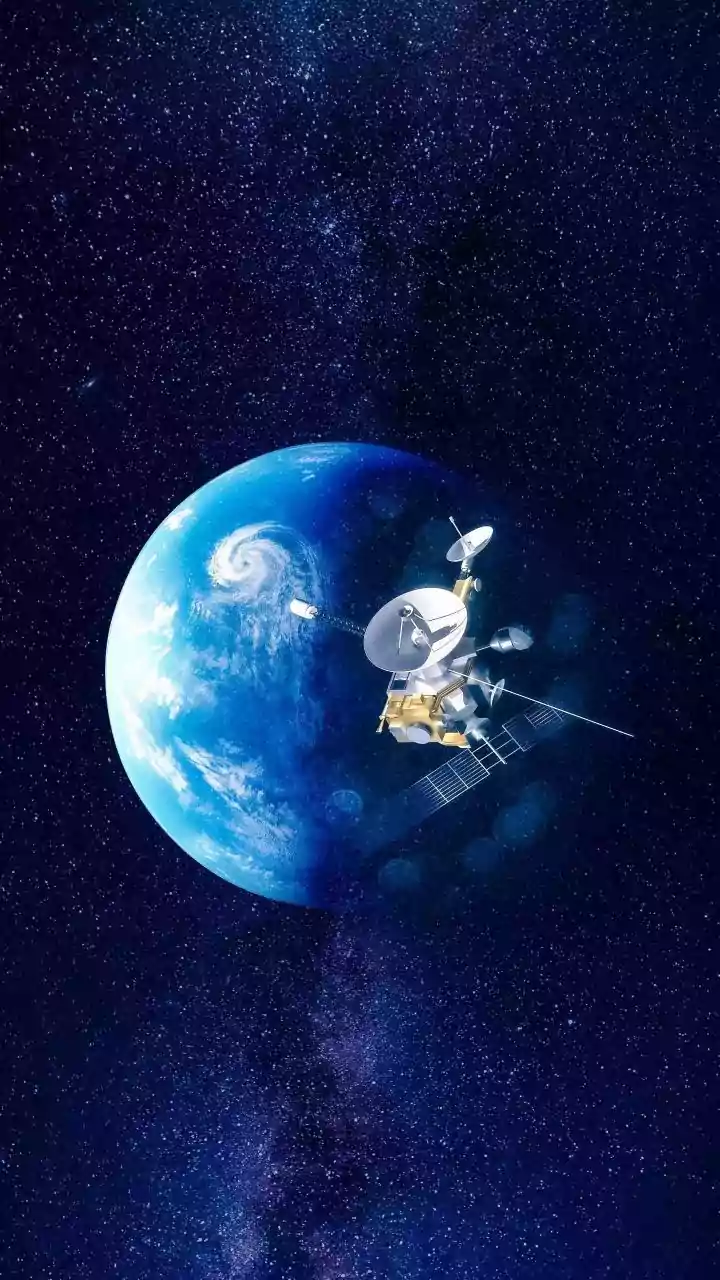
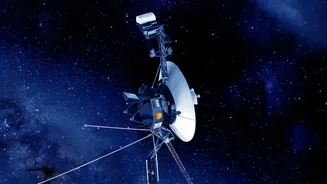
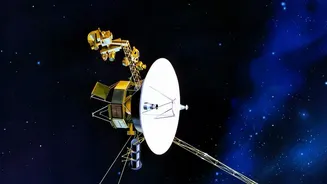
It is the most distant object humanity has ever sent into the cosmos. NASA's Voyager 1 spacecraft is now so far away that a message, travelling at the speed of light, takes a full 24 hours to reach it. But what does that really mean?
Putting a Light-Day in Perspective
A light-day is not
a measure of time, but of distance. It's how far a beam of light travels in a vacuum in 24 hours. That distance is immense: approximately 25.9 billion kilometers, or about 16.1 billion miles. To put that into perspective, light from the Sun takes only eight minutes to reach Earth. A signal sent to Voyager 1 takes 180 times longer. If you wanted to send a 'hello' to the distant probe, you would have to wait a full 48 hours for a reply to get back to you, a two-day round trip for a simple text message across the solar system. This incredible distance makes every communication with the aging spacecraft a monumental exercise in patience and precision for the engineers at NASA's Jet Propulsion Laboratory.
Our Most Distant Messenger
Launched on September 5, 1977, Voyager 1 was tasked with a 'Grand Tour' of the outer planets. It flew past Jupiter in 1979 and Saturn in 1980, using their immense gravity to slingshot itself towards the edge of our solar system at a blistering speed of over 60,000 kilometers per hour. Its primary mission delivered a treasure trove of discoveries, including active volcanoes on Jupiter's moon Io and the complex structure of Saturn's rings. After its planetary encounters, its mission was extended. It became a pioneer, journeying into the unknown space beyond our planetary neighborhood. In 1998, it overtook the Pioneer 10 probe to become the most distant human-made object in space, a title it has held ever since.
Crossing into Interstellar Space
In August 2012, Voyager 1 achieved a historic first: it crossed the heliopause, the boundary where the Sun's constant stream of particles and magnetic fields gives way to the interstellar medium. It became the first object built by humanity to enter the space between the stars. It has not completely left the solar system, however; it will take another 300 years to reach the inner edge of the Oort Cloud, a vast, theoretical shell of icy objects surrounding our Sun. But it is now officially sailing in an entirely new ocean, directly sampling the environment of the Milky Way galaxy. Its remaining instruments 'hear' the vibrations of interstellar plasma, sending back data from a region we have only ever observed from afar.
A Fading Whisper and a Golden Record
After nearly half a century in the harsh environment of space, Voyager 1 is showing its age. Its power, supplied by decaying plutonium, diminishes by about four watts every year. To conserve energy, engineers have been shutting down its systems one by one. Its cameras were turned off in 1990 after taking the iconic 'Pale Blue Dot' photo of Earth from a distance of 6 billion kilometers. Yet it continues to send back invaluable data. Bolted to its side is the Golden Record, a gold-plated copper disk containing sounds and images selected to portray the diversity of life and culture on Earth. It carries greetings in 55 languages, music from different eras and cultures, and natural sounds, serving as a message in a bottle for any civilization that might one day encounter it.