

The Ultimate Entry Problem
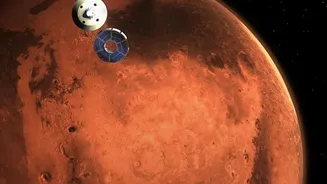
Landing on Mars is famously difficult, a process engineers at NASA have dubbed the 'seven minutes of terror'. The trouble starts with the planet's atmosphere. It’s thick enough to create incredible friction and heat—enough to incinerate a spacecraft—but
it's 100 times thinner than Earth’s, meaning it's not dense enough to slow a craft down sufficiently with just a parachute. An arriving vehicle hits the top of the atmosphere at around 20,000 km/h. In just a few minutes, it must autonomously decelerate to a complete stop, using a complex sequence of a heat shield, a supersonic parachute, and finally, powered descent with rockets. This entire sequence must be performed perfectly by the onboard computer, as the communication delay between Mars and Earth means that by the time mission control receives the signal that entry has begun, the craft has already been on the surface—intact or in pieces—for several minutes.
Touching Down Safely
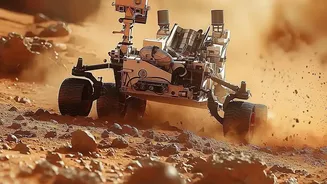
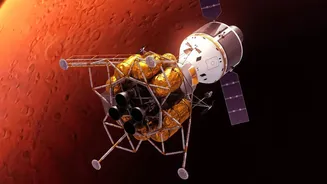
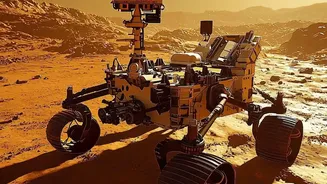
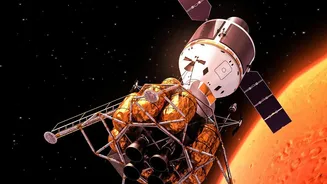
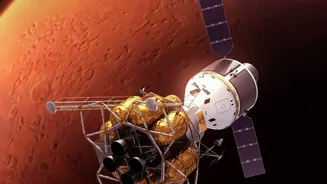
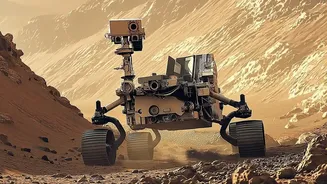
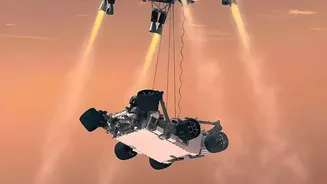
The final moments of landing are just as fraught with risk. Early, smaller rovers used airbags to bounce to a stop. However, for larger payloads like the SUV-sized Perseverance rover, NASA developed the 'Sky Crane' maneuver. This system uses a rocket-powered jetpack to hover above the surface while lowering the rover on tethers, before flying off to crash-land a safe distance away. While a proven success for one-tonne rovers, this technology has likely reached its limit. A future human mission would require landing a payload of 40 to 80 tonnes, including astronauts, habitats, supplies, and a return vehicle. This exponential increase in mass demands entirely new landing technologies that have not yet been invented, let alone tested in the unforgiving Martian environment.
The Robot Revolution
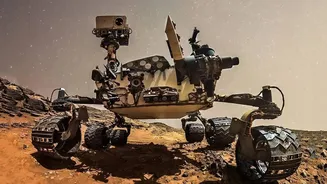
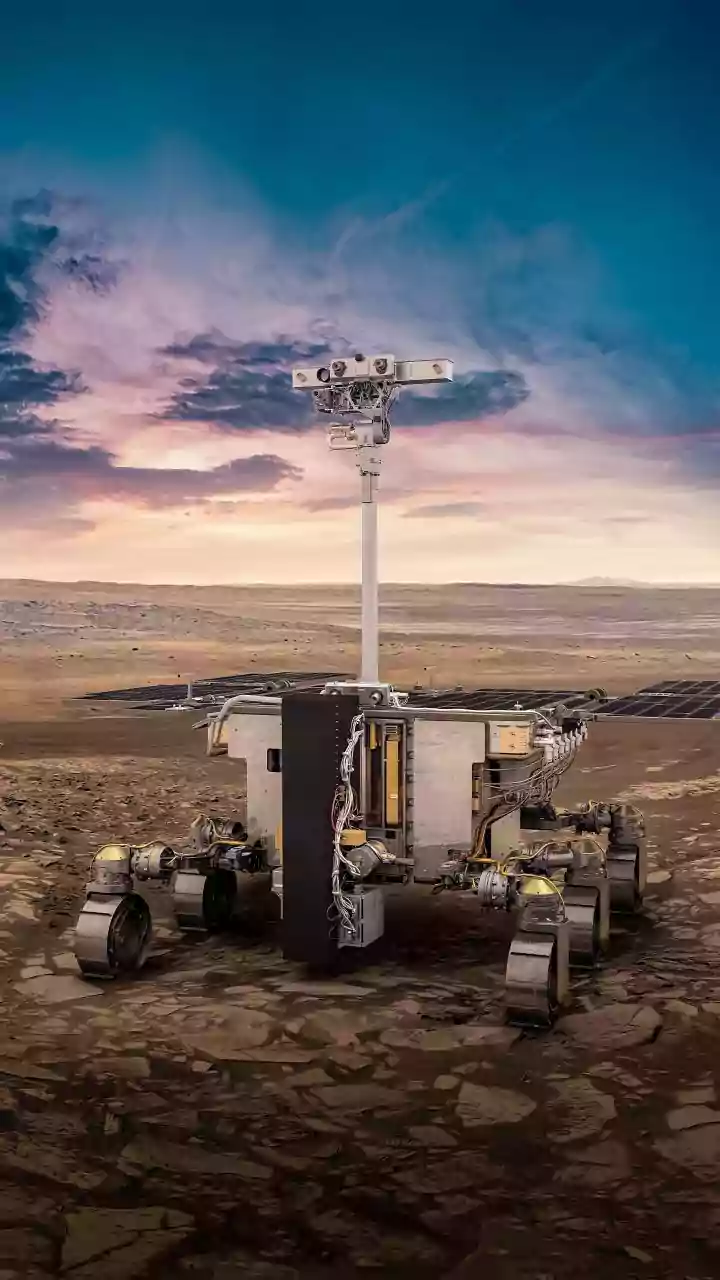
For now, robots are the undisputed kings of Mars exploration. They are our eyes, ears, and hands on the Red Planet. The arguments for robotic missions are compelling. First, there is the cost. A mission like the Perseverance rover cost under $3 billion, whereas even the most conservative estimates for a crewed Mars mission start at $100 billion and can go as high as half a trillion dollars or more. Robots don't need life support, food, water, or a return ticket, all of which add immense mass and complexity to a mission. They can also tolerate extreme radiation and operate for many years, far beyond their initial mission timelines, patiently gathering data in a way that is impossible for humans. Over decades, robotic explorers have fundamentally reshaped our understanding of Mars, proving it was once a world with lakes, rivers, and a thicker atmosphere.
The Human Touch
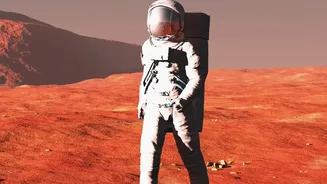
Despite the success of robots, the call for human exploration remains strong. The key advantage is adaptability and speed. A human geologist could accomplish in a single week what it might take a rover an entire year to do. Humans can intuitively identify interesting features, make split-second decisions, and perform complex physical tasks that are far beyond the capabilities of a pre-programmed machine. Imagine a rover getting stuck in sand—a mission-ending event. A human could simply walk around the obstacle. Furthermore, a human presence allows for much deeper and more complex scientific investigation, such as operating deep drills or identifying subtle fossilized microbes that a robot's sensors might miss. Proponents argue that true exploration is, by its very nature, a human endeavor.
A Hybrid Future
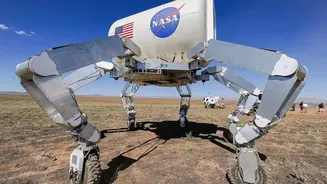
The debate between robotic and human exploration is not necessarily an either-or proposition. The most likely path forward is a synergistic one, where robots continue to act as scouts and assistants. Future missions could see advanced robots sent ahead to prepare a landing site, deploy habitats, and test resource-gathering technologies before the first humans even leave Earth. Once on the surface, astronauts could work alongside robotic companions, sending them into hazardous areas or using them for heavy-duty construction and maintenance. This hybrid approach leverages the strengths of both: the resilience, precision, and low cost of robots combined with the ingenuity, adaptability, and on-the-spot problem-solving skills of human explorers. It allows us to manage risk while pushing the boundaries of what is possible.