


A Spectrum of Colours
First, it helps to remember what light is. The light we see from the Sun or reflected off the Moon isn't just one colour; it's a full spectrum of colours, famously remembered by the acronym ROYGBIV (Red, Orange, Yellow, Green, Blue, Indigo, Violet). Each
of these colours travels in waves, and each has a unique wavelength. Red and orange have long, stretched-out wavelengths, while blue and violet have short, choppy ones.
Earth's Atmospheric Gauntlet
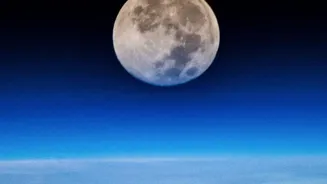
Our planet is wrapped in a thick blanket of air we call the atmosphere. This isn't just empty space; it's a sea of tiny gas molecules, primarily nitrogen and oxygen, along with dust, pollen, and other minuscule particles. For light from any celestial object—the Sun, a star, or the Moon—to reach our eyes, it must first pass through this atmospheric gauntlet. As it travels, the light waves interact with these particles, leading to a phenomenon called scattering.
The Science of Scattering
The key to the red moon mystery lies in a process called Rayleigh scattering, named after the 19th-century physicist Lord Rayleigh. This principle states that when light encounters particles much smaller than its wavelength, it gets scattered in all directions. However, not all colours are scattered equally. Shorter wavelengths—like blue and violet—are much more easily bounced around by atmospheric molecules than longer wavelengths like red and orange. This very effect is why our sky appears blue; during the day, blue light is scattered across the entire sky, reaching our eyes from all directions.
The Horizon Effect
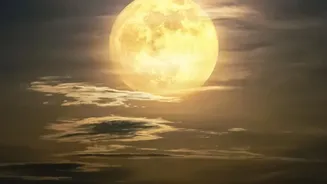
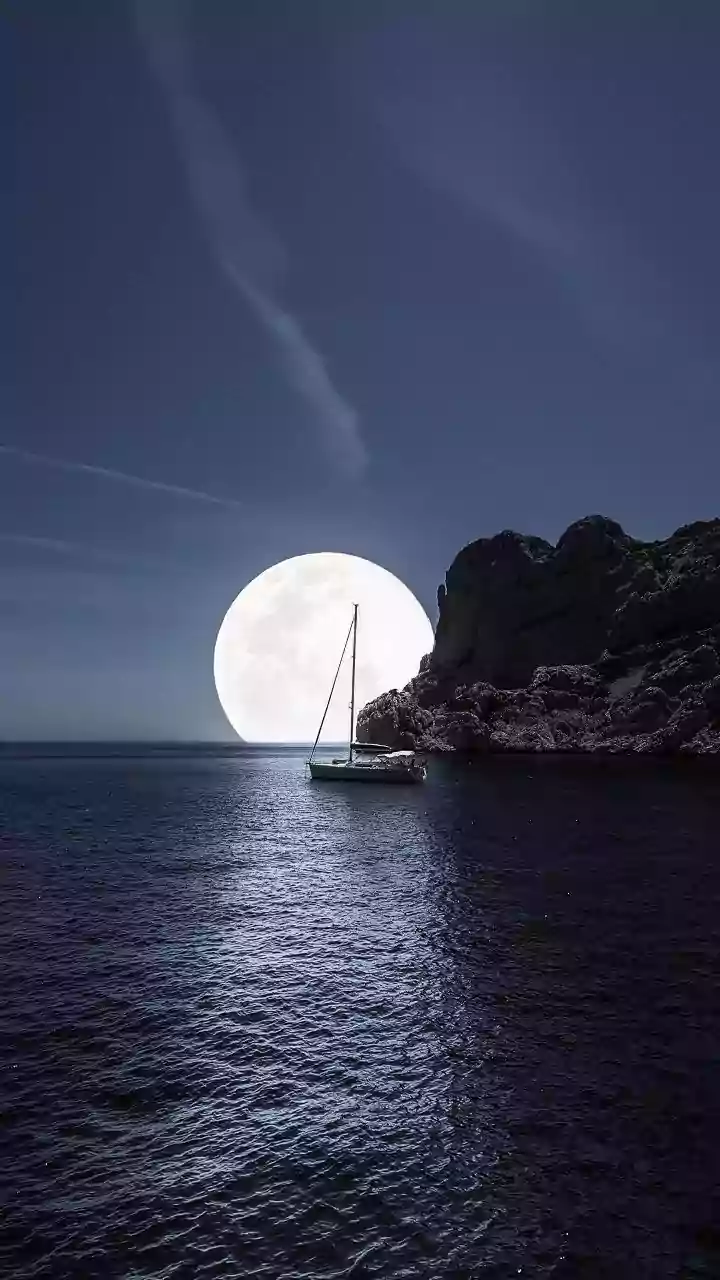
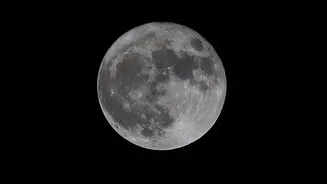
So, how does this make the Moon turn red? It all comes down to the angle at which we view it. When the Moon is high overhead, its light takes a relatively direct and short path through the atmosphere to reach us. But when the Moon is near the horizon, during moonrise or moonset, its light has to travel through a much thicker slice of Earth’s atmosphere. Think of it as looking through the very edge of the atmospheric blanket, which is much denser than looking straight up through its thinnest part.
Red Light's Triumphant Journey
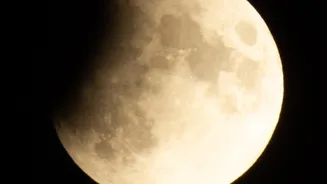
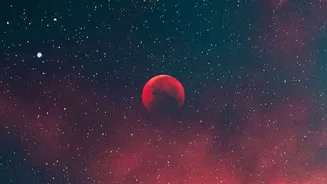
During this long journey through the dense, horizon-level atmosphere, most of the short-wavelength blue and violet light is scattered away from our line of sight. It gets bounced around so much that it never completes the trip to our eyes. The longer-wavelength red, orange, and yellow light, however, is far less affected by the atmospheric particles. It powers through the haze, completing its journey relatively intact. The result is that the light we end up seeing is dominated by these warm colours, making the Moon appear to be glowing red or orange.
Not Just the Moon
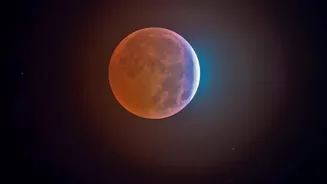
This same atmospheric filtering effect is responsible for the vibrant colours of sunrises and sunsets. When the Sun is low on the horizon, its light follows the same long, particle-filled path, scattering the blues and letting the reds and oranges shine through. Air pollution, dust, and smoke can enhance this effect, as more particles in the air lead to more scattering and even deeper red hues. This is also distinct from a 'Blood Moon', which occurs during a total lunar eclipse when the Moon passes through Earth's shadow.