



A Second Act for a Space Hero
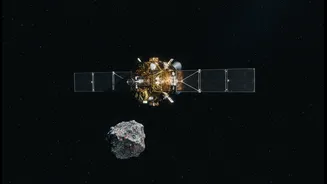
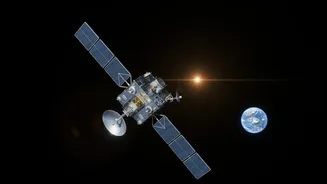
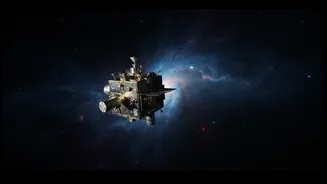
The Japan Aerospace Exploration Agency (JAXA) designed the Hayabusa2 spacecraft for a specific, ambitious purpose: to rendezvous with the near-Earth asteroid Ryugu, collect pristine samples from its surface, and return them to Earth. Launched in 2014,
it executed this mission flawlessly. In 2018, it reached Ryugu, deployed rovers, and even created an artificial crater to grab subsurface material. By December 2020, its precious cargo was safely back in the hands of scientists, offering unprecedented insights into the building blocks of our solar system. For most spacecraft, this would mark a triumphant end. But Hayabusa2 was still healthy, fully functional, and drifting through space with plenty of fuel. JAXA decided its hero’s journey wasn't over; it was just beginning a new chapter.
A High-Speed Gamble at Torifune
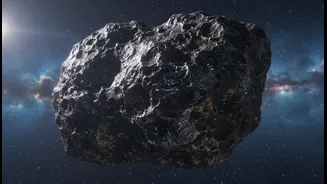
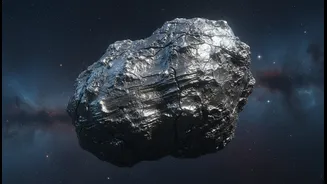
On July 5, 2026, Hayabusa2 undertook a task it was never built for. It performed a daring, high-speed flyby of a completely different asteroid named (98943) Torifune. Instead of the slow, careful approach it used at Ryugu, the probe screamed past Torifune at a relative speed of five kilometers per second, or about 18,000 kilometers per hour. It came within just 800 meters of the 450-meter-wide space rock. This was a significant engineering challenge, described by some on the mission team as a 'risky operation.' The spacecraft was originally designed for hovering and rendezvous, not high-speed interception. Success depended on sophisticated autonomous optical guidance software, allowing the probe to track and photograph a fast-moving, unknown object without real-time human control.
New Science and Stunning Images
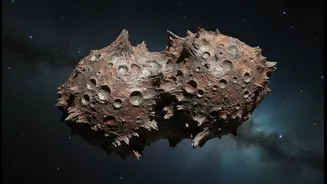
The gamble paid off handsomely, yielding both stunning images and new science. The pictures sent back revealed Torifune to be a 'contact binary'—a celestial body that looks like two distinct lobes fused together, resembling a peanut. This suggests it was formed when two separate objects gently collided and stuck together, providing scientists with a real-world look at how planetesimals, the precursors to planets, may have grown in the early solar system. Furthermore, Torifune is a different class of asteroid than Ryugu, allowing for a valuable comparison. By studying its composition and how its surface has been altered by solar wind and micrometeorite impacts, scientists can piece together a more complete history of our cosmic neighborhood.
A Rehearsal for Planetary Defense
Beyond the geological science, the flyby served a more urgent purpose: it was a critical dress rehearsal for planetary defense. If scientists were to discover a hazardous asteroid on a collision course with Earth, the first step would be to launch a rapid reconnaissance probe to understand the threat. The Torifune flyby was a dry run for just such a scenario, proving that a spacecraft can autonomously intercept and analyze an unknown object at high speed. This maneuver provides invaluable data for developing 'kinetic impactor' strategies, like NASA's DART mission, which aim to deflect dangerous asteroids by crashing a probe into them. The precision navigation required for the Torifune flyby is the exact same technology needed to ensure an impactor hits its target millions of miles away.
The Future of Space Exploration
The saga of Hayabusa2 is a powerful demonstration of a growing trend in space exploration: getting more out of what we’ve already built. Mission extensions are an incredibly economical way to conduct new science. With the massive cost of design, launch, and travel already paid, a healthy spacecraft becomes a priceless asset for new discoveries. The Torifune flyby wasn’t even Hayabusa2's final act. The probe is now using gravity assists from Earth to slingshot itself toward a third target: a tiny, rapidly spinning asteroid named 1998 KY26, which it is expected to reach in 2031. This final rendezvous will push the veteran explorer’s capabilities even further.