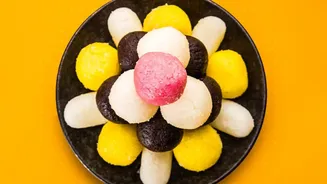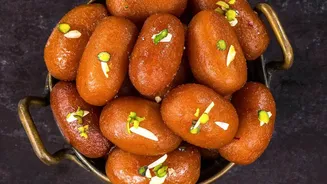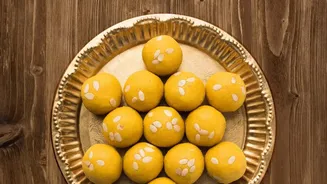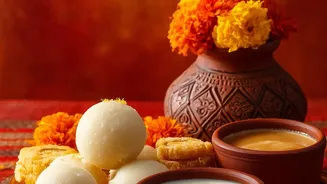


Modak from Maharashtra
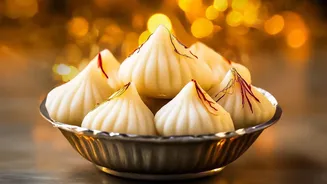
These delicate, steamed rice-flour dumplings are synonymous with Ganesh Chaturthi, especially in Maharashtra. The sweet is said to be a favourite of Lord Ganesha. Legend tells of a competition between Ganesha and his brother Kartikeya for a single, divine
modak that granted great wisdom. Ganesha won by cleverly circling his parents, declaring them his world. This story cements the modak's place as an offering symbolizing wisdom and devotion. The outer casing of rice flour and the inner filling of fresh coconut and jaggery reflect the coastal and agricultural abundance of the region. Its distinct pleated shape, often made by hand, is a culinary art form passed down through generations.
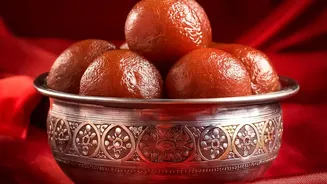
Gujiya from North India
Come Holi, and homes across North India are filled with the aroma of frying gujiyas. These crescent-shaped pastries are filled with a rich mixture of khoya (milk solids), dried fruits, and nuts. While its exact origins are debated, some historians trace it back to a 13th-century sweet-and-honey-filled pastry, while others see influences from the Turkish baklava or a sweet version of the samosa. It became particularly prominent in the Braj region around Mathura and Vrindavan, where it is offered to Lord Krishna. The tradition is so old that some temples in Vrindavan have a 500-year-old practice of serving Gujiya. This half-moon pastry is a taste of joy, shared among friends and family after playing with colours.
Thekua from Bihar & Jharkhand
Thekua is the soul of Chhath Puja, the ancient festival dedicated to the Sun God. This hard, biscuit-like sweet is made from wheat flour, ghee, and jaggery or sugar, and often flavoured with cardamom and coconut. Its significance lies in its purity and simplicity; it's a sattvik offering made with ingredients from the recent harvest, symbolizing gratitude to the sun for the crops. Traditionally prepared on earthen stoves using mango wood for fuel, the process is as sacred as the prayer itself. The intricate designs pressed onto the dough using wooden moulds are a hallmark of this beloved prasad.
Puran Poli from Maharashtra & The Deccan
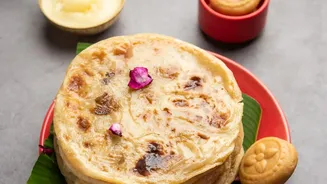
A soft, sweet flatbread, Puran Poli is a staple during festivals like Holi, Gudi Padwa, and Ganesh Chaturthi across the Deccan plateau. The name describes its components: 'puran' is the sweet lentil filling made from chana dal and jaggery, while 'poli' is the outer bread. Mentions of a similar dish date back to ancient Sanskrit texts, with its clear origins in the medieval Deccan region. It's known by many names—Holige in Karnataka, Bobbatlu in Andhra Pradesh—each with slight regional variations in the filling and preparation. Served warm with a dollop of ghee, it is a comforting food that represents hospitality and festive indulgence.
Mysore Pak from Karnataka
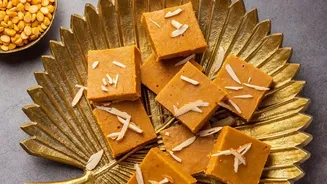
This rich, ghee-laden sweet was born from a happy accident in the royal kitchens of the Mysore Palace. In the early 20th century, a palace cook named Kakasura Madappa was experimenting with gram flour, ghee, and sugar for King Krishnaraja Wadiyar IV. When the king asked for the name of the delicious, melt-in-your-mouth creation, the cook simply called it 'Mysore Pak', or the confection from Mysore. It was immediately declared a royal sweet. Today, it has become a signature sweet of South India, essential for celebrations like Diwali and Dussehra, representing a legacy of royal patronage and culinary ingenuity.
Sandesh from Bengal
Delicate and subtly sweet, Sandesh is the pride of West Bengal, especially during Durga Puja. Its name means 'message', hinting at its traditional role in conveying good news and affection. Made from fresh chhena (curdled milk), the modern form of Sandesh gained popularity in the 19th century, possibly influenced by Portuguese cheese-making techniques. However, the name itself appears in medieval Bengali literature, referring to an older sweet made from solidified kheer. Today, it comes in countless varieties, from the simple 'kanchagolla' (raw balls) to elaborately moulded and flavoured creations, making it a symbol of Bengali hospitality and artistry.
Sakkarai Pongal from Tamil Nadu
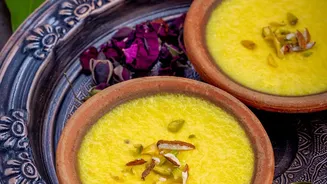
Sakkarai Pongal is the heart of the Tamil harvest festival, Pongal. The name of the festival itself means 'to boil over', symbolizing abundance and prosperity. This sweet dish is a pudding made from newly harvested rice, moong dal, jaggery, and jaggery, and is often cooked in clay pots in the open, under the sun, as an offering to the Sun God. According to one legend, the festival is tied to Lord Shiva, who sent his bull to earth, leading to an association with cattle and bountiful harvests. The bubbling over of the pot is a moment of great joy, and the sweet pongal is offered as prasad, a thanksgiving for nature's bounty.