




1. A Day That Lasts Longer Than a Year
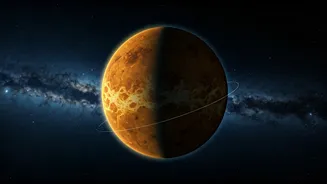
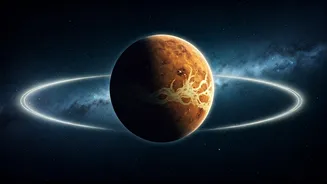
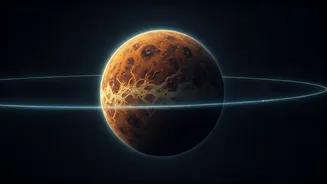
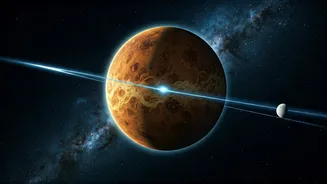
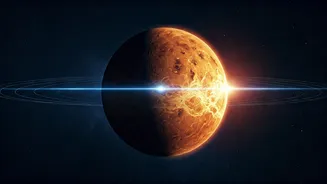
Let’s start with the most mind-bending fact of all, the one that makes our 24-hour cycle feel lightning-fast. While Venus takes about 225 Earth days to complete one orbit around the Sun (its year), it takes a staggering 243 Earth days to rotate just once
on its axis. Imagine that: a single day on Venus is longer than its entire year. The Sun would rise, crawl across the sky for months, and set, but by the time the same spot on the planet faces the Sun again, Venus would have already completed its trip around the Sun and then some. This isn't just a snail's pace; it's a cosmic crawl that completely redefines the concepts of 'day' and 'night'.
2. The Planet That Spins Backwards
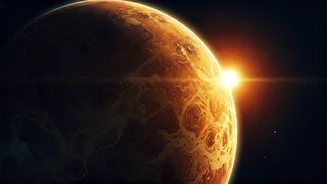
If the long day wasn’t strange enough, Venus also has a peculiar sense of direction. Most planets in our solar system, including Earth, rotate on their axis from west to east. This is why our Sun appears to rise in the east and set in the west. Venus, however, is the rebel of the solar system. It spins in the opposite direction, a phenomenon known as retrograde rotation. If you could stand on the surface of Venus (which you can't, but we'll get to that), the Sun would appear to rise in the west and set in the east. Scientists theorise this could be the result of a massive collision with an asteroid early in its history, one powerful enough to literally flip its world upside down or reverse its spin.
3. A Surface Straight Out of Hell
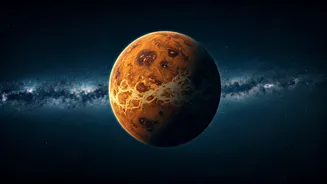
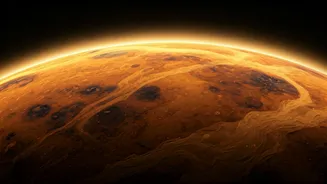
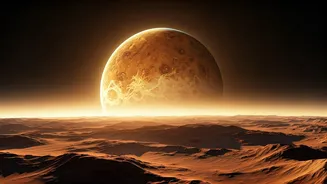
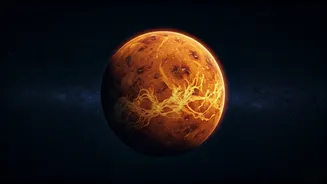
Venus may be named after the Roman goddess of love and beauty, but its surface is anything but lovely. The planet is shrouded in a thick, toxic atmosphere that creates an extreme greenhouse effect. This traps heat so effectively that the surface temperature averages a scorching 465 degrees Celsius. That's hot enough to melt lead. But the heat is only half the problem. The atmospheric pressure on the surface is over 90 times that of Earth's. Standing on Venus would feel like being nearly a kilometre deep in our ocean—an immense, crushing force that would instantly flatten any spacecraft not specifically designed to withstand it, like the Soviet Venera landers of the 1970s and 80s which survived for only minutes.
4. Clouds Made of Acid
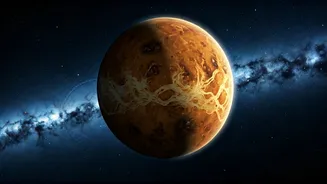
The thick, yellowish clouds that give Venus its bright, serene appearance from Earth are hiding a nasty secret. They aren't made of water vapour like the clouds on Earth. Instead, they are composed primarily of sulphuric acid droplets. These clouds blanket the entire planet in multiple layers, extending from about 48 to 70 kilometres in altitude. While the planet's surface is too hot for rain as we know it, the upper atmosphere experiences a perpetual drizzle of corrosive acid. This 'acid rain' evaporates long before it ever reaches the ground due to the intense heat, creating a volatile and toxic atmospheric cycle.
5. A Planet's Rotation That Ebbs and Flows
Just when you think Venus couldn't get any stranger, recent studies have revealed something truly bizarre: the length of its day isn't constant. Researchers using radar observations over several years discovered that the planet's rotation speed seems to fluctuate, causing the length of a Venusian day to vary by several minutes. The leading hypothesis is that the planet's incredibly thick atmosphere—more than 96% carbon dioxide and 50 times more massive than Earth's—is to blame. The dense, fast-moving winds drag on the planet's surface, exchanging momentum with the solid planet itself and causing it to slightly speed up and slow down. It's as if the weather on Venus is so extreme it can physically change the planet's rotation.