
Meet the Super-Earths
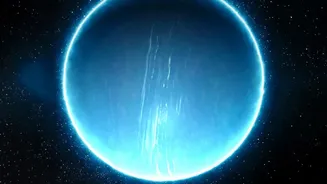
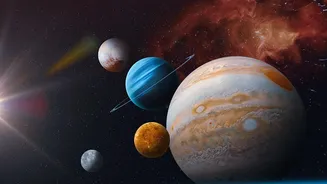
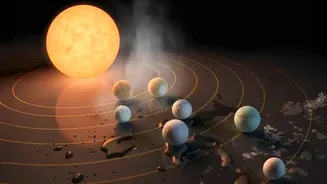
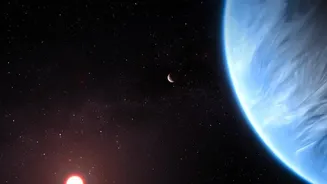
Among the thousands of exoplanets discovered, one of the most common types is the 'Super-Earth'. These are worlds more massive than our own but smaller than ice giants like Neptune. They represent a fascinating middle ground, potentially rocky like Earth but with
characteristics we can only begin to imagine. Scientists estimate there could be tens of billions of Super-Earths in our Milky Way galaxy alone, many orbiting in the 'habitable zone' of their star where conditions might allow for liquid water. Their size is a double-edged sword; a larger mass could help a planet retain a thick, protective atmosphere and a magnetic field, both crucial for habitability. But it could also lead to crushing gravity and a runaway greenhouse effect, creating a world entirely hostile to life as we know it.
The Art of Reading Starlight
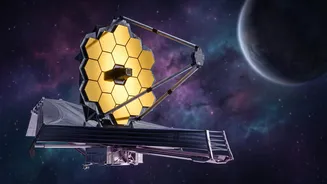
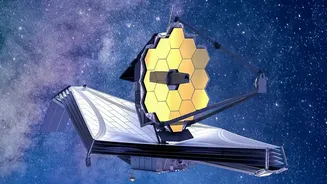
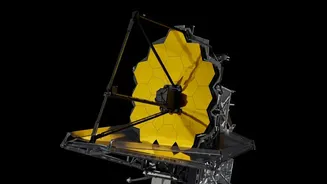
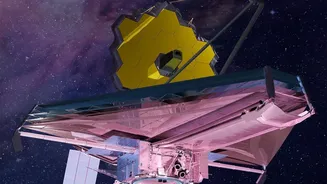
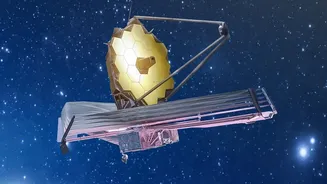
So, how can a telescope 1.5 million kilometres from Earth analyze the air of a planet hundreds of light-years away? The answer lies in a technique called transit spectroscopy. When an exoplanet passes, or 'transits', in front of its host star from our perspective, a tiny fraction of the starlight filters through the planet's atmosphere. The James Webb Space Telescope's incredibly sensitive infrared instruments, like the Near-Infrared Spectrograph (NIRSpec) and the Mid-Infrared Instrument (MIRI), can capture this filtered light and spread it into a spectrum—a rainbow of infrared colours. Different molecules in the atmosphere absorb specific wavelengths of light, leaving behind a unique chemical 'fingerprint'. By reading these patterns, astronomers can identify the atoms and molecules present, including the one most crucial for life: water.
A Steamy Atmosphere Detected
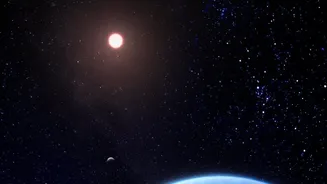
Recent observations have put this technology to the test on several Super-Earths. One notable subject is K2-18 b, a planet where water vapour has been detected. Webb's analysis went further, finding carbon-bearing molecules like methane and carbon dioxide, while noting a surprising lack of ammonia. This specific chemical cocktail supports the intriguing hypothesis that K2-18 b could be a 'Hycean' world—a planet with a hydrogen-rich atmosphere covering a liquid water ocean. On another world, the scorching hot Super-Earth GJ 486 b, Webb also detected hints of water vapour. At 430 degrees Celsius, this planet is far from habitable, but the presence of an atmosphere would be a monumental discovery in itself, suggesting rocky planets can maintain their skies even in extreme environments.
The Habitable Planet Question
Detecting water vapour is a landmark achievement, but it's not the same as finding a glistening blue ocean. Scientists are careful to manage expectations. The signal from GJ 486 b, for instance, could be coming from cool spots on its host star, which can also harbor water vapour, rather than the planet itself. Even if the water is planetary, it doesn't guarantee habitability. A world like K2-18 b might not have a distinct surface but could instead be a 'gas dwarf' with a deep, crushing atmosphere where the water exists as high-pressure steam, far too hot for life. The difference between a habitable water world and an uninhabitable steamy gas planet is a fine line that requires more observation to resolve. These initial findings are not an answer, but rather the opening of an entirely new chapter of scientific inquiry.
What the Future Holds
The James Webb Space Telescope is just getting started. Each new observation provides a richer, more detailed molecular and chemical portrait of these distant worlds. The data gathered so far is already revolutionizing our understanding of planetary formation and evolution. Future observation campaigns will target more Super-Earths, dedicating precious telescope time to re-observe the most promising candidates to confirm initial findings and build a more complete picture. Scientists will be able to compare the atmospheric compositions of multiple planets within the same system, looking for tell-tale signs like reduced carbon dioxide that could hint at a large-scale liquid ocean. While Webb might not give us the final answer on alien life, it is providing the crucial, foundational data that will guide the search for decades to come, transforming these faint points of light into tangible places.