


The Universe's Ultimate Speed Limit
The secret to this cosmic time travel lies in a fundamental rule of our universe: the speed of light. While it’s incredibly fast — about 300,000 kilometres per second, fast enough to circle the Earth more than seven times in a single second — space is incomprehensibly
vast. This means that even at this breakneck speed, light takes time to travel from a star to your eye. Astronomers use a unit called a 'light-year' to measure these immense distances. It’s not a measure of time, but of distance: the distance light travels in one year. That's a staggering 9.5 trillion kilometres. So when we say a star is 10 light-years away, we mean its light has been journeying through the vacuum of space for a full decade to reach us.
An Eight-Minute-Old Sun
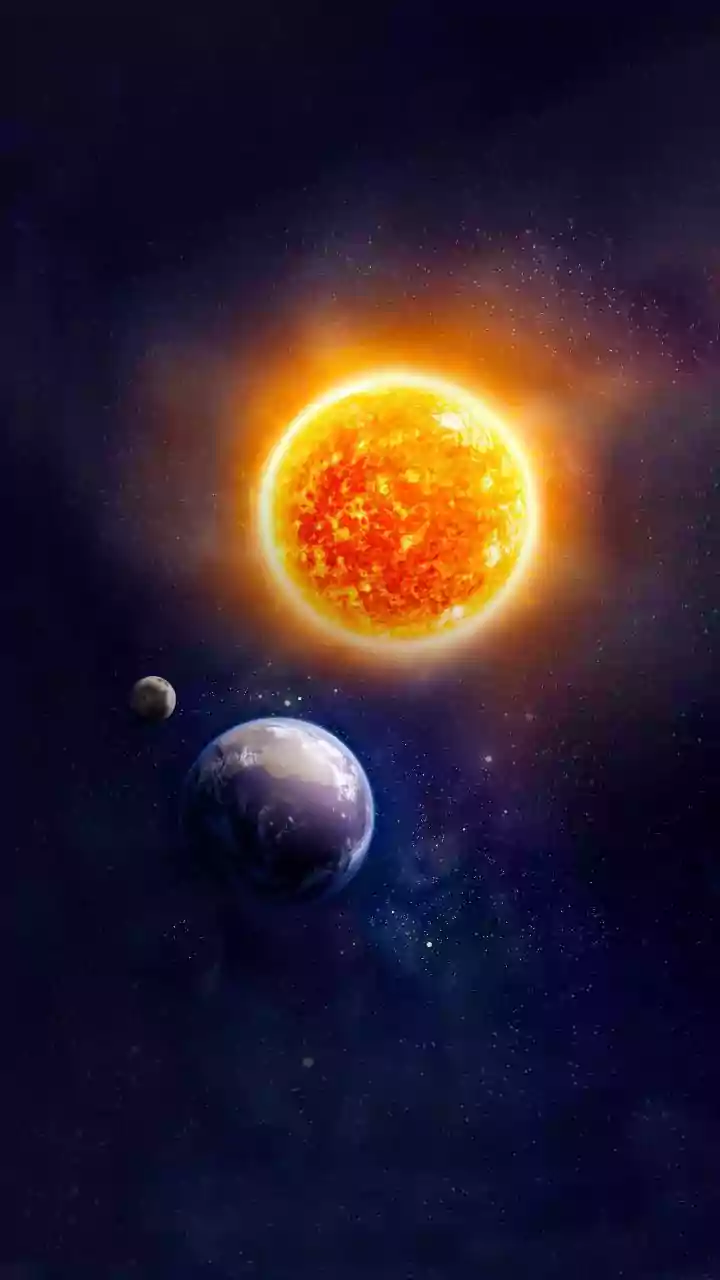
You don't even have to wait for nightfall to experience this phenomenon. The closest star to us is our own Sun. It is about 150 million kilometres away. As fast as light is, it still takes approximately 8 minutes and 20 seconds to travel from the Sun’s surface to Earth. This means that if the Sun were to suddenly vanish, we wouldn’t know about it for over eight minutes. Every time you feel its warmth on your skin, you are basking in energy that left the Sun before your current cup of chai was finished brewing. The sunlight you see is always, technically, from the past.
Messages from Recent History
As we look further out, the time delays get much, much longer. Take Sirius, the brightest star in our night sky, easily visible from India. It shines so brilliantly because it’s relatively close, but 'close' in cosmic terms is still a long way off. Sirius is about 8.6 light-years away. The light you see from Sirius tonight began its journey in 2015 or 2016. When that light left its surface, Virat Kohli was cementing his captaincy of the Indian cricket team and the world was just getting used to digital payment platforms that are now commonplace. The light from our nearest stellar neighbours is a time capsule from the world of the recent past.
Echoes from Distant Centuries
Let’s look at a more famous star: Polaris, the North Star. For centuries, it has been a guide for travellers. Polaris is much further away, at an estimated 323 to 433 light-years. Let’s take a conservative estimate of around 400 years. This means the light from Polaris we see tonight started its journey around the early 1620s. When that light set off, the Mughal emperor Jahangir was on the throne, the Taj Mahal had not yet been conceived, and William Shakespeare’s plays had only recently been compiled into the First Folio. You are literally seeing the star as it appeared during a completely different era of human history.
The Deepest History You Can See
Some stars visible to the naked eye send us messages from even deeper in the past. The giant red star Betelgeuse, one of the corners of the Orion constellation, is about 640 light-years away. The light striking your retina from Betelgeuse tonight left the star around the year 1380, during the reign of the Tughlaq dynasty in the Delhi Sultanate. You are seeing light that is older than the discovery of America, the invention of the printing press, and the entire Mughal Empire.
And if you are in a very dark place, far from city lights, you might be able to spot a faint, fuzzy patch in the sky: the Andromeda Galaxy. This is not a star but a collection of a trillion stars, and it's the most distant object you can see with your unaided eye. It is 2.5 million light-years away. The light from it you see tonight began its journey when our earliest human ancestors were first walking the Earth. It is a photon-sized postcard from a time before human history even began.