







Cosmic Lighthouses in the Deep
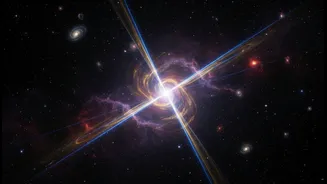
Pulsars are the incredibly dense, spinning remnants of massive stars that have gone supernova. A typical pulsar packs more mass than our sun into a sphere just the size of a city, making it one of the most extreme environments in the universe. Their intense
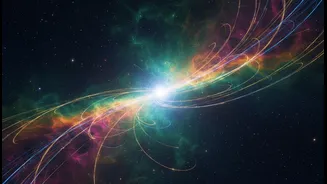
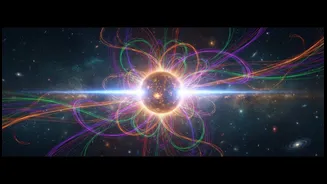
magnetic fields, trillions of times stronger than Earth's, generate powerful beams of radiation from their magnetic poles. As the pulsar spins, these beams sweep through space. If one happens to cross our line of sight, we see a regular pulse of energy, hence the name 'pulsar.' For decades, this 'lighthouse model' has been central to our understanding, but we could never see the 'light source'—the spots on the surface—directly.
Charting the Unseen with NICER
Enter NASA's Neutron star Interior Composition Explorer (NICER), a high-precision X-ray telescope installed on the International Space Station. By meticulously tracking the X-rays streaming from pulsars, NICER can measure their arrival times to within a hundred nanoseconds. This incredible precision allowed scientists to do something once thought impossible: create a map of a pulsar's surface. Focusing on a pulsar named J0030, located about 1,100 light-years away, researchers used NICER's data to chart the location and shape of its 'hot spots'—the superheated areas at the base of its magnetic field that act as the source of the lighthouse beams.
A New Chapter for Pulsar Physics
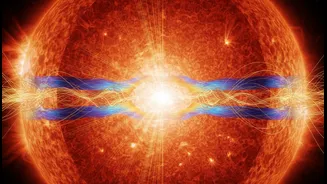
The results from the NICER map were stunning and completely unexpected. The classic textbook model of a pulsar showed two simple, circular hot spots, one at each magnetic pole. NICER revealed a much stranger reality. Instead of two neat spots on opposite sides, J0030 has its hot spots all located in its southern hemisphere. Furthermore, the spots aren't simple circles; one is a small, round patch, while another is a long, crescent-shaped arc. This discovery completely upended the simple 'bar magnet' model of pulsars. It proves that their magnetic fields are far more complex and tangled than previously theorized, forcing physicists to rewrite the textbooks on the fundamental structure and behaviour of neutron stars.
Nature's Ultimate Accelerators
This new, complex map has profound implications for another great mystery: high-energy particle acceleration. Pulsars are nature's most powerful particle accelerators, using their rotating magnetic fields to whip charged particles to near the speed of light. These particles are what generate the beams we detect and are a major source of high-energy cosmic rays that bombard Earth. However, the exact mechanism has been difficult to model without knowing the precise shape of the magnetic fields doing the accelerating. By revealing the true, complicated structure of the fields at the surface, the NICER map provides the first real-world data to feed into simulations. Scientists can now test their theories against this new reality, getting closer to understanding how these cosmic engines work and how they influence our galaxy.