



A Geometric Storm Brews
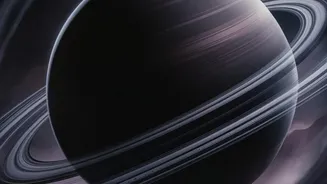
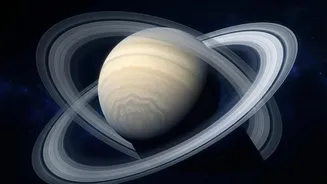
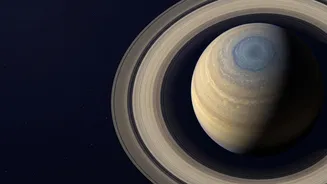
In recent observations, scientists have confirmed the existence of a massive, 10-sided atmospheric wave, or decagon, encircling Saturn’s south pole. This surprising discovery was made using data from the Hubble Space Telescope, following initial hints
spotted by amateur astronomers in 2024 and 2025. Unlike the stable, 40-year-old hexagon at the planet's north pole, this southern decagon appears to be a brand-new feature, having only become distinct since 2023. This gives scientists a rare and exciting opportunity to watch a large-scale planetary weather system form and evolve in near real-time, something that has never been witnessed before.
A Tale of Two Poles
For years, the northern hexagon was considered a unique oddity. Discovered by the Voyager spacecraft in the 1980s, the six-sided jet stream is a stable, long-lasting feature. Scientists had long searched for a southern counterpart, but NASA’s Cassini spacecraft, which orbited Saturn from 2004 to 2017, found no evidence of a similar long-lived polygon at the south pole. The emergence of the decagon changes everything. It suggests that the formation of such geometric storms is a fundamental process in Saturn's atmosphere, not a one-off fluke. The key difference, however, is that the hexagon is remarkably stable, while the decagon is a dynamic, evolving system, offering a different kind of natural laboratory for study.
The Science Behind the Shape
So, how does a planet’s atmosphere create a 10-sided storm? These geometric shapes are essentially massive waves within powerful jet streams that circle the planet’s poles. On gas giants like Saturn, fast rotation and deep atmospheric convection create the conditions for these jet streams to become unstable in a very organized way, forming persistent polygonal patterns. The northern hexagon is thought to be a towering structure, extending hundreds of miles deep into the atmosphere. Early observations of the new southern decagon suggest it is also not just a cloud-top feature but a vertically extended structure that penetrates multiple atmospheric layers. The precise reasons for a storm having ten sides instead of six are still under investigation, but may be linked to wind speeds and the presence of other nearby vortices.
Clues for Weather Here and Beyond
Studying these extreme weather systems on Saturn provides crucial insights into the fundamental physics that governs all planetary atmospheres, including our own. Understanding how such stable, energetic vortices form helps scientists refine the models used to predict weather and climate. While Saturn’s storms are vastly different from Earth’s hurricanes, the underlying principles of fluid dynamics are universal. The sudden formation of the decagon highlights how much planetary atmospheres can change, challenging the view that gas giants are timeless and unchanging. This discovery not only deepens our understanding of the Saturnian system but also provides a valuable framework for studying the atmospheres of exoplanets, worlds orbiting distant stars, where similar phenomena might be occurring.