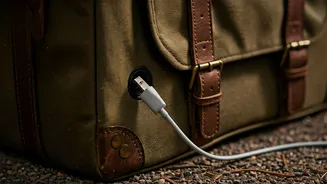









The Illusion of Convenience
Let's be honest about what that built-in USB port actually is. It is not a magical, self-charging source of power. In nearly all cases, it's simply a pass-through cable—a short extension cord that connects a power bank you have to provide on the inside
to a device you plug into the outside. The marketing pitch is convenience: no need to open your bag to access your power bank. This sounds great in a controlled environment like an airport lounge, where you can neatly prop your bag next to you. But the reality of travel, especially rugged trekking, is rarely so neat and tidy. The perceived convenience quickly evaporates when you consider the trade-offs in durability, weight, and versatility, revealing the feature for what it often is: a gimmick designed to look good on a shop floor, not to perform in the field.
An Extra Point of Failure
Every component you add to a piece of gear is a potential point of failure. For trekking luggage, which is subjected to rain, dust, impacts, and rough handling, this principle is doubly important. A USB port is a particularly vulnerable component. The external port is exposed to the elements; a bit of moisture or grit can easily corrode the contacts and render it useless. The internal cable can get snagged, bent, or crushed by the contents of your pack. When it breaks—and it will likely break long before the durable fabric and sturdy zippers of the bag itself—you're left with a dead port. Worse, you’re left with a hole in your bag that compromises its water resistance. You’ve effectively paid a premium for a feature that weakens the overall integrity of your luggage.
The Superiority of a Standalone Power Bank
The alternative is not only simpler but vastly superior: a high-quality, standalone power bank. This approach is modular, meaning each part of your system can be repaired or upgraded independently. When your power bank dies or a new, more efficient model comes out, you can replace it without ditching your entire bag. A standalone unit is also more versatile. You can carry it in your jacket pocket for a quick charge on the go, take it into your tent at night, or leave it to charge at a cafe while your main bag is locked up in a hostel. It isn't tethered to a 30-litre backpack. Modern power banks are rugged, water-resistant, and offer multiple ports with advanced charging technologies like Power Delivery (PD) that the cheap, built-in cables in luggage rarely support. You get more power, faster charging, and greater flexibility without compromising your bag’s durability.
Built-In Tech Equals Built-In Obsolescence
Technology evolves at a blistering pace. The USB-A port that is standard on most luggage today is already being phased out in favour of the more powerful and versatile USB-C. In a year or two, a bag with only a USB-A port will feel dated. By integrating a specific type of technology directly into the fabric of the bag, manufacturers are building in obsolescence. A well-made trekking pack should last you a decade or more. Your charging technology will likely be updated three or four times in that same period. Tying the fate of your long-lasting gear to a short-lived piece of tech is a poor long-term investment. A modular approach ensures your core equipment—the bag itself—remains timeless and functional, while your electronics can be updated as needed.