







A New Era of Open Space Data
For decades, the intricate data streams from spacecraft were the exclusive domain of mission controllers and agency scientists. With the Artemis program, however, NASA is ushering in a new era of transparency and public engagement. Following the successful
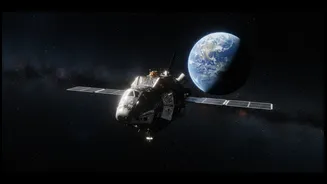
uncrewed Artemis I flight and the crewed Artemis II lunar flyby, a wealth of data from the Orion spacecraft is being made public. This initiative is not just about sharing information; it's about fostering collaboration, inspiring the next generation of engineers, and allowing the public to feel a direct connection to humanity's journey into deep space. The data allows for independent analysis, educational projects, and even artistic creations, democratizing space exploration in a way that was previously unimaginable.
Your Gateway: Where to Find the Data
NASA has centralized its public data offerings, making it easier than ever to dive into the numbers behind the missions. The primary hub for enthusiasts is the Artemis Real-time Orbit Website (AROW). Available on NASA's website and the NASA app, AROW provides a real-time visualization of the Orion spacecraft's position, speed, and distance from both Earth and the Moon during missions. It turns raw telemetry into an intuitive and engaging experience. For those seeking more granular information, NASA's Open Data Portal at data.nasa.gov is a comprehensive repository. This site catalogs thousands of datasets, while api.nasa.gov provides programmatic access for developers. Specific to Artemis, the JPL Horizons system offers precise orbital data, or ephemeris, for the Orion spacecraft.
For Engineering Students: Real-World Projects
The availability of Orion's flight data presents an unparalleled opportunity for engineering students. Instead of relying solely on theoretical models, students can now work with real-world data from a deep-space mission. NASA makes downloadable ephemeris data—a detailed set of state vectors describing Orion's exact location and movement—available through the AROW site. This data can be used for projects in orbital mechanics, enabling students to reconstruct the spacecraft's trajectory, verify its path, and compare flight-derived data with their own simulations. Furthermore, data from Orion's systems, including performance of the European Service Module (ESM) which provides power and propulsion, can inform projects on spacecraft design, thermal analysis, and life support systems. Universities are already integrating this data into their curriculum, giving students hands-on experience and a direct link to the challenges and triumphs of space exploration.
For Space Fans: Visualizing the Journey
Artemis followers can move beyond simply watching launch videos and engage directly with the mission's progress. The AROW website and NASA app are the perfect tools for this. During Artemis II's historic 10-day flight around the Moon, the public was able to track the crew's journey in near real-time. The app even features an augmented reality function that allows you to point your phone at the sky and see Orion's position relative to you on Earth. Beyond tracking, the data provides context. You can see key mission milestones, learn about the Apollo landing sites as Orion passes over them, and truly grasp the immense distances involved. For those with an eye for coding or visualization, the publicly available APIs and trajectory data allow for the creation of custom trackers, dashboards, and even artistic representations of the mission.
Understanding the Data You Can Access
It's important to understand the types of data available. The most accessible information is positional and trajectory data, including velocity, altitude, and distance. This is what powers the AROW visualizer. More advanced users can access the ephemeris data, which provides precise state vectors over time. Beyond that, NASA's Open Data Portal provides access to a wider range of scientific data from instruments on various missions, such as magnetic field and plasma data from earlier Artemis-related probes. While the full, raw, high-frequency telemetry from every sensor on Orion isn't typically released in real-time to the public, the post-mission data analysis and published findings provide deep insights for engineers. NASA's commitment to releasing verified data ensures that students, developers, and the public have a robust and accurate foundation for their work.