





To solve the biggest mystery in the cosmos, sometimes you have to look at the smallest things imaginable. A recent discovery has done just that, opening a new window into an unimaginably tiny realm to hunt for clues about dark matter.
A Needle in a Trillion Haystacks
After a search spanning
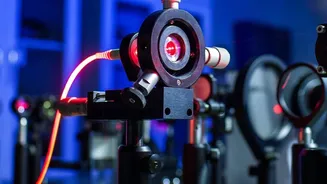
more than 40 years, physicists at CERN's Large Hadron Collider (LHC) have found the first evidence of a particle decay so incredibly rare it's like finding one specific grain of sand on all the world's beaches. Scientists at the LHCb experiment, one of the major detectors at the LHC, observed a 'beauty' particle (specifically a Bd meson) decaying into two smaller particles called muons. This event is predicted to happen only once in every ten billion beauty particle decays. Finding it required sifting through an astronomical amount of data from collisions happening at nearly the speed of light. An upgraded detector and sophisticated machine learning techniques allowed the team to finally isolate the faint signal from overwhelming background noise.
Welcome to the Zeptoverse
The headline event is happening on a scale so small it has earned the nickname the 'zeptoverse'. A zeptometer is a trillionth of a billionth of a metre (10 to the power of -21), a distance about 100 billion times smaller than an atom. This is the strange, quantum world where the fundamental particles that make up our reality live and interact. While the LHC is the most powerful microscope ever built, it cannot see directly into the zeptoverse. Instead, physicists use it to study the after-effects. By precisely measuring how particles decay, they can detect the influence of other particles or forces, even ones they cannot create or see directly, that might be hiding at these extreme scales.
Testing the Universe's Rulebook
The current 'rulebook' for particle physics is called the Standard Model. It has been incredibly successful at describing the fundamental particles and forces of nature. However, physicists know it is incomplete. Rare decays like this one are a perfect way to stress-test the Standard Model. The rarer the decay, the more sensitive it is to the influence of new, undiscovered particles. If the measured rate of this decay was different from the Standard Model's prediction, it would be a flashing red sign pointing toward new physics. As it happens, the measurement, which has a statistical significance of 3.2 sigma (making it 'evidence' but not yet a 'discovery'), is consistent with the Standard Model's prediction. This doesn't mean the search is over; it just narrows the places where new physics could be hiding.
The Dark Matter Connection
So, where does dark matter fit in? The Standard Model has no explanation for this mysterious substance, which makes up about 85% of the matter in the universe. Scientists believe that whatever dark matter is, it must be made of particles that we haven't discovered yet. Some theories suggest these unknown particles could subtly interact with the known particles of the Standard Model, slightly changing the rates of very rare processes. By measuring this one-in-ten billion decay, physicists are essentially checking to see if any such influence is present. While this result showed no deviation, it places powerful new constraints on theories that try to explain dark matter. It helps rule out certain possibilities, allowing researchers to refine their search and focus on more promising theories about where these elusive particles might be found.