






The Pacific Player: El Niño and La Niña
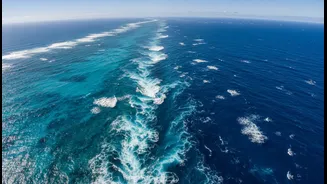
The most famous of these climate drivers is the El Niño-Southern Oscillation (ENSO), which plays out in the vast equatorial Pacific Ocean. ENSO has two main phases: El Niño and La Niña. During normal conditions, trade winds blow warm surface water from
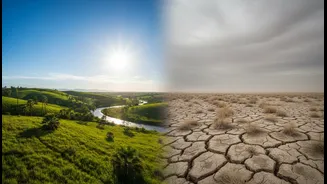
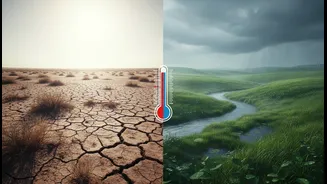
east to west, from South America towards Asia. In a La Niña phase, these winds strengthen, often leading to increased rainfall for the Indian monsoon. However, during an El Niño, these trade winds weaken or even reverse. Warm water pools in the central and eastern Pacific, disrupting global weather patterns. For India, an El Niño event typically means a weaker monsoon, suppressing rainfall and increasing the risk of drought. The atmospheric changes caused by a warm Pacific often lead to drier air and subsidence over the subcontinent, robbing the monsoon of its vital moisture.
The Indian Ocean's Own: The Dipole
Closer to home, the Indian Ocean has its own powerful climate pattern, known as the Indian Ocean Dipole (IOD). Sometimes called the 'Indian El Niño', the IOD is about the temperature difference between the western Indian Ocean (near the Arabian Sea) and the eastern Indian Ocean (near Indonesia). The IOD has three phases. In a 'positive' IOD, the western Indian Ocean becomes warmer than the east. This temperature difference helps push moisture-laden winds towards India, enhancing the monsoon and often bringing above-average rainfall. A 'negative' IOD does the opposite, with the eastern Indian Ocean warming, pulling moisture away from India and weakening the monsoon. A 'neutral' phase has little influence.
A Complex Climate Tug-of-War
The critical question for India's weather is how these two patterns interact. They can either work together or against each other. A La Niña in the Pacific and a positive IOD is a dream combination for a bountiful Indian monsoon. Conversely, an El Niño paired with a negative IOD can lead to severe drought conditions. The most complex scenario is when they are in opposition, creating a climatic tug-of-war. A strong positive IOD can sometimes partially offset the drying effect of an El Niño, helping to rescue the monsoon from a complete failure. This has happened in the past, such as in 1997 and 2019, where a robust positive IOD helped moderate the rainfall deficit caused by El Niño conditions. However, this is not guaranteed and depends on the timing and strength of both phenomena.
The Outlook for 2026: A Season on Edge
As of July 2026, India is grappling with this very complexity. Climate agencies have confirmed that El Niño conditions are not only present but are strengthening and expected to become a strong event. This has contributed to a significant rainfall deficit in the early part of the monsoon season. The crucial variable is the IOD. Forecasts have been mixed. While some models suggest a positive IOD could develop later in the season, particularly from July or August, others like the IMD have forecast it to remain neutral. If a positive IOD does develop and strengthen, it could offer some relief and boost rainfall in the latter half of the monsoon season (August-September). However, most forecasts caution that the strong El Niño is the dominant factor, and even with some help from a positive IOD, the overall monsoon rainfall for 2026 is likely to remain below normal.